

AI Without a Data Foundation:
Why It Fails Before It Starts
Artificial intelligence delivers the greatest value when it is built on a strong data foundation. Organizations that prioritize data quality, governance, and
integration are far more likely to scale AI initiatives successfully. By modernizing data infrastructure and aligning initiatives with business outcomes,
enterprises can turn AI from experimentation into a measurable advantage.
AI Success Starts Long Before the Model
Artificial intelligence is quickly moving from experimentation to expectation. Boards are asking about it. Investors are evaluating it. And leadership teams increasingly view it as a catalyst for growth, efficiency, and better decision-making.
Yet the organizations seeing the greatest results are not necessarily the ones adopting AI the fastest. They are the ones preparing the right data foundation before deploying advanced tools.
According to Gartner, the lack of AI-ready data remains one of the biggest obstacles to scaling AI initiatives. Organizations that focus on data governance, integration, and quality significantly increase their likelihood of successful adoption.
The lesson for business leaders is clear: AI success begins with data readiness. When organizations treat data as a strategic asset rather than a technical byproduct, AI becomes a practical tool for improving decisions, managing risk, and unlocking new opportunities.
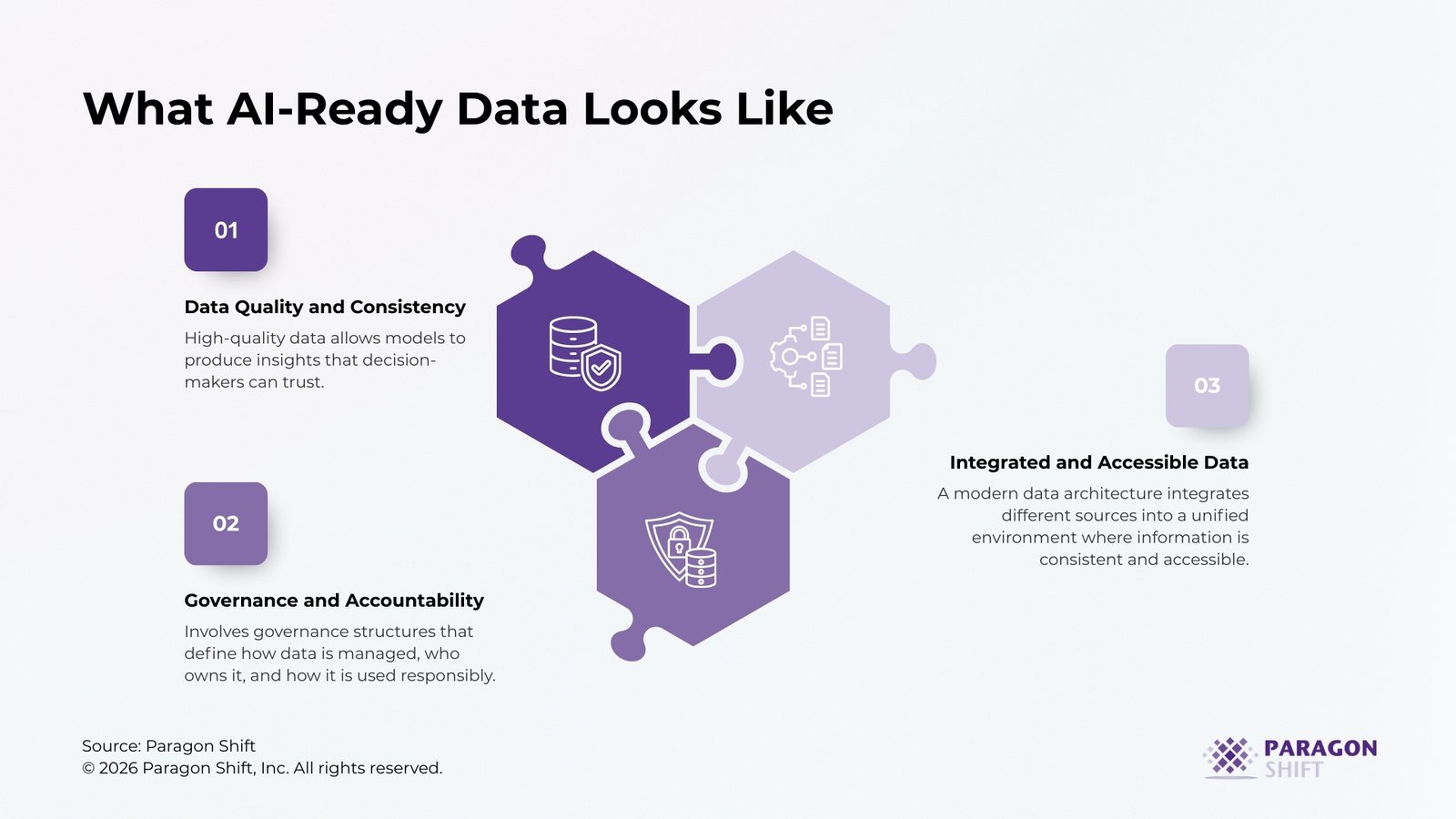
What AI-Ready Data Actually Looks Like
Before organizations can generate value from AI, they must build a data environment designed for reliability, transparency, and scale.
This foundation typically includes three essential elements:
Data Quality and Consistency
AI systems learn patterns from historical data. The reliability of their outputs depends heavily on the consistency and completeness of the data used to train them.
Organizations that prioritize data quality establish processes to ensure information is accurate, standardized, and continuously validated. This includes resolving duplicates, aligning definitions across departments, and maintaining consistent data structures.
High-quality data allows models to produce insights that decision-makers can trust. Research from MIT Sloan highlights that companies with strong data quality practices are significantly more likely to generate measurable value from analytics initiatives.
Governance and Accountability
Successful AI initiatives are rarely purely technical projects. They involve governance structures that define how data is managed, who owns it, and how it is used responsibly.
Effective data governance establishes:
- clear ownership and stewardship
- defined standards for data management
- policies for privacy and compliance
- traceability for data lineage
These frameworks ensure that data remains reliable, auditable, and aligned with regulatory requirements.
Similarly, the NIST AI Risk Management Framework emphasizes governance as a central requirement for trustworthy AI systems.
Integrated and Accessible Data
AI performs best when it can access information across the organization. However, many companies still operate with fragmented data environments where information resides in separate operational systems.
A modern data architecture integrates these sources into a unified environment where information is consistent and accessible. This allows models to learn from broader patterns across operations, finance, and customer interactions.
According to McKinsey, organizations with integrated data platforms are significantly more likely to scale analytics initiatives successfully across departments.
The Strategic Shift: From AI Projects to Data Strategy
Organizations often view AI as a discrete technology initiative. However, the companies that see the most value approach it differently.
They begin by strengthening their data strategy. A modern data strategy focuses on creating a scalable environment where data supports multiple business functions, from reporting and analytics to automation and predictive modeling.
This shift requires leadership alignment across three key areas:
Business-Driven Use Cases
AI initiatives are most effective when they are tied directly to business priorities. Instead of experimenting broadly, organizations should identify specific challenges where data-driven insights can improve performance.
Examples include:
- forecasting demand in supply chains
- detecting operational anomalies
- improving financial forecasting
- optimizing customer engagement
Aligning AI initiatives with measurable business outcomes ensures that investments deliver tangible value.
Data Modernization
Legacy infrastructure often limits the ability to analyze and operationalize data effectively. Data modernization initiatives address these limitations by updating how information is stored, integrated, and accessed.
Key modernization initiatives often include consolidating fragmented data sources, implementing cloud-based data platforms, standardizing data models across systems, and automating data pipelines.
These improvements create the technical environment required for scalable analytics and AI. Deloitte reports that organizations investing in data modernization are far more likely to transition from experimental analytics to enterprise-wide adoption.
Organizational Alignment
Technology alone does not create value. Successful AI adoption requires coordination between leadership, data teams, and operational stakeholders.
This includes executive sponsorship of data initiatives, collaboration between IT and business functions, training and adoption across departments, and clearly defined governance structures.
When leadership establishes shared ownership of data strategy, AI initiatives move beyond experimentation and become embedded in daily operations.
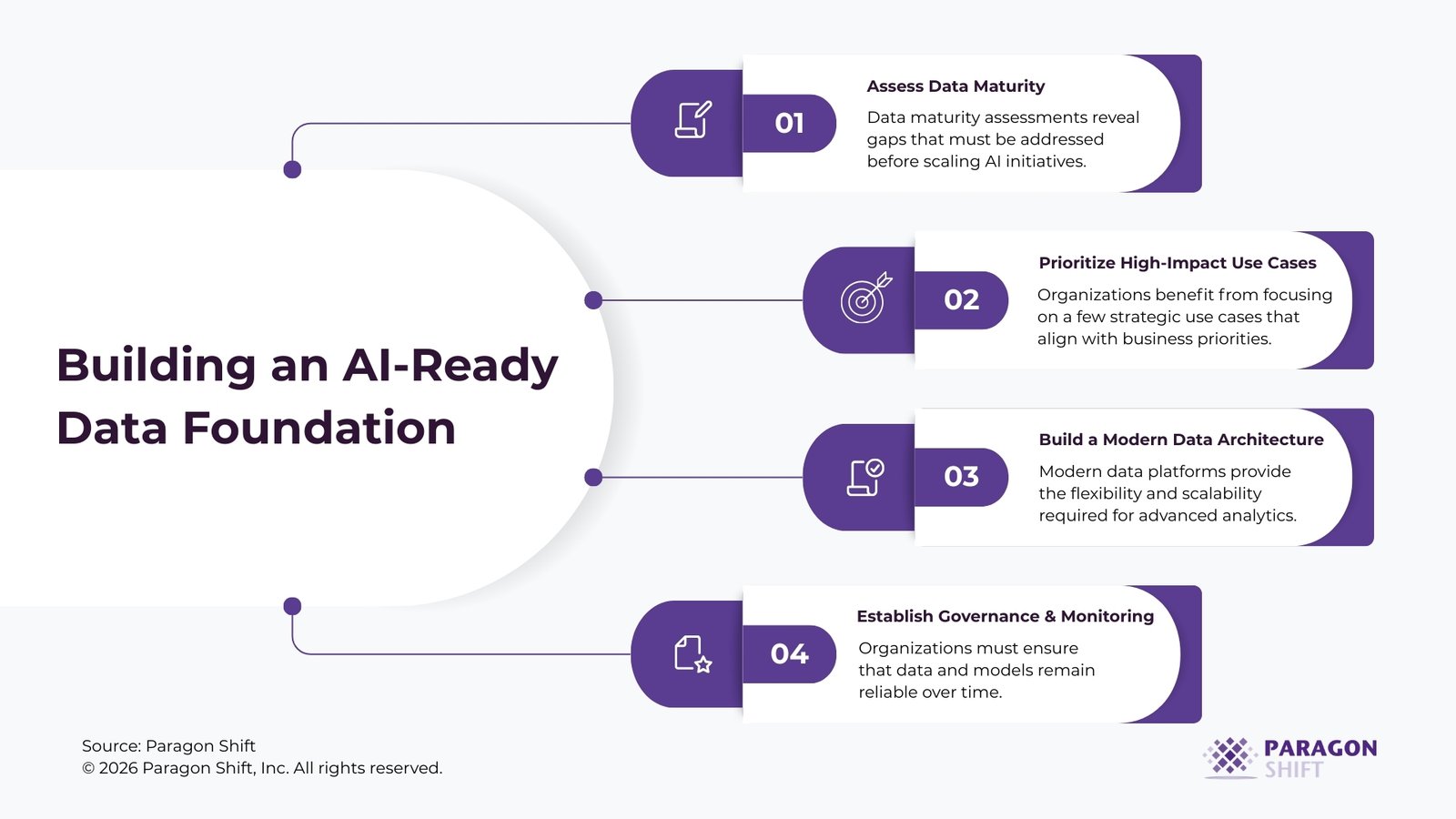
A Practical Framework for Building an AI-Ready Data Foundation
For many organizations, the question is not whether AI will be adopted but how to prepare for it effectively.
A practical roadmap typically involves four steps:
Step 1: Assess Data Maturity
The first step is understanding the current state of the organization’s data environment. This includes evaluating:
- data quality
- governance processes
- integration across systems
- accessibility for analytics
Data maturity assessments reveal gaps that must be addressed before scaling AI initiatives.
Step 2: Prioritize High-Impact Use Cases
Rather than launching multiple AI experiments simultaneously, organizations benefit from focusing on a small number of strategic use cases that align with business priorities. This approach allows leadership teams to demonstrate value quickly while building confidence in data-driven decision-making.
Step 3: Build a Modern Data Architecture
Modern data platforms provide the flexibility and scalability required for advanced analytics. By integrating operational systems into a unified environment, organizations create a single source of truth for decision-making. This infrastructure enables both traditional analytics and more advanced AI capabilities.
Step 4: Establish Governance and Monitoring
Finally, organizations must ensure that data and models remain reliable over time. Governance frameworks should include processes for monitoring data quality, tracking model performance, and managing updates as business conditions evolve. Continuous oversight ensures that AI initiatives remain aligned with organizational goals.
Turning Data Readiness into Competitive Advantage
When organizations invest in their data foundations, the benefits extend far beyond AI itself.
A strong data environment supports:
- faster and more confident decision-making
- improved operational efficiency
- better risk management
- scalable analytics initiatives
Companies that treat data as a strategic capability gain an advantage not only in AI adoption but across the broader digital transformation landscape. As McKinsey notes, organizations that successfully scale analytics and AI typically begin by strengthening their data ecosystems and governance structures.
Data First, Value Follows
AI has enormous potential to transform how organizations operate. But its effectiveness depends heavily on the environment in which it operates.
Organizations that focus first on data readiness, governance, and integration create conditions where AI can deliver meaningful insights and operational improvements.
Rather than rushing toward new tools, the most successful companies begin with a simple principle: Build the data foundation first. Then scale the intelligence that depends on it.