Work Hours
Monday to Friday: 7AM - 7PM
Weekend: 10AM - 5PM


Data Engineering Mistakes That Break
AI Projects
Here is our perspective on why AI projects stall: in most cases, the model was never the problem. The data engineering layer underneath it was. This article diagnoses the four
data engineering mistakes that break AI programs most consistently, with clear explanations, real-world examples, and actionable fixes for each.
When an AI project stalls, the diagnosis is almost always framed as a model problem. The accuracy was not high enough. The training data was too small. The algorithm was not the right fit. These explanations are technically adjacent to the truth but rarely the actual cause. In the overwhelming majority of cases, the model was fine. The data engineering layer underneath it was not.
Gartner predicts that through 2026, organizations will abandon 60 percent of AI projects that are not supported by AI-ready data. The word “abandon” is important. These are not projects that failed technically. They are projects that could not be defended when the data foundation was scrutinized by a business stakeholder who questioned the model’s outputs, by a regulator who asked where the training data came from, or by an operations team that discovered the model was running on data that did not reflect current conditions.
Gartner’s Q3 2024 survey of 248 data management leaders found that 63 percent of organizations either lack or are unsure whether they have the right data management practices for AI. That figure is not a technology readiness gap. It is a data engineering gap; the distance between how data is currently managed and how it needs to be managed for AI to work reliably in production.
Informatica’s CDO Insights 2025 survey identified the top obstacles to AI success as data quality and readiness, cited by 43 percent of respondents, followed by lack of technical maturity at 43 percent and shortage of skills at 35 percent. None of these obstacles is a model problem, and instead, data engineering problems that were present before the model was built and remained unresolved when it failed.
This article diagnoses the four data engineering mistakes that most consistently break AI programs. Each section explains the mistake, why it happens organizationally, and what the fix looks like in practice.
Mistake 1: Treating Data Pipelines as Reporting Infrastructure Rather Than AI Infrastructure
What it is
Most enterprise data pipelines were not built for AI. They were built for reporting. The distinction matters more than it appears.
A reporting pipeline is designed to produce a consistent, formatted output on a defined schedule. It tolerates some latency. It handles data quality issues through manual review at the reporting stage. It is optimized for human consumption of aggregated results. A batch refresh that runs overnight and powers a dashboard used in the morning review meeting is performing exactly as designed.
An AI pipeline is fundamentally different. A machine learning model trains on data that must be consistent in structure, accurate at the field level, temporally aligned across sources, and representative of the distribution the model will encounter in production. A model that trains on a dataset assembled by a reporting pipeline with its batch latency, manual quality interventions, and aggregation logic that discards the granularity ML requires will produce outputs that are unreliable in ways that are difficult to diagnose because the pipeline, not the model, is the source of the problem.
Why it happens organizationally
Most CDOs and CDAOs inherit data infrastructure built for analytics and BI. When an AI program is approved, the natural assumption is that the existing data estate can support it. The data is already flowing. The pipelines are already running. The temptation is to connect the AI program to the existing infrastructure and see what the model produces.
What the model produces, in this situation, is a proof-of-concept that works adequately on historical data and degrades when deployed against live production data because the live pipeline has the same structural limitations as the historical one. However, the model has no way to signal that the data it is receiving is not fit for the inference it is being asked to perform.
The fix
Gartner’s February 2025 guidance on AI-ready data defines the requirement precisely: AI-ready data must be aligned to specific use cases, actively governed at the asset level, supported by automated pipelines with quality gates, managed through live metadata, and continuously quality-assured. The word “continuously” is the operational distinction. Traditional data pipelines run quality checks at reporting cadences, including quarterly audits, monthly pipeline reviews, and annual governance assessments. AI models in production need data quality signals measured in hours. The pipeline architecture must change to reflect that.
In practice, this means introducing quality gates at every ingestion step, not just at the output, so that data quality failures are detected before they reach the model rather than after the model has already produced an output no one trusts. It means replacing batch aggregation logic with feature-level granularity that preserves the dimensional information ML models need. And it means designing the pipeline for the specific feature set the model requires, not for the general reporting schema the warehouse currently supports.
A healthcare system building a patient readmission prediction model discovered this problem six months into the program. The model was trained on a dataset assembled from the clinical data warehouse, which aggregated patient records at the encounter level to support utilization reporting. The model needed event-level data to learn the clinical trajectory that precedes readmission. The warehouse did not store it. The pipeline had been discarding it for years because reporting did not require it. The fix required redesigning the pipeline to preserve event-level clinical data, work that should have preceded model development, not followed it.
Mistake 2: Assuming Training Data and Production Data Are Equivalent
What it is
This is the mistake that causes the most expensive form of AI failure: a model that performs well in evaluation and degrades in production. The failure mode is called data drift, which is the divergence between the statistical distribution of the data the model was trained on and the distribution of the data it encounters when deployed. It is silent, gradual, and often invisible until a business consequence makes it undeniable.
Data drift has two primary causes in enterprise environments. The first is temporal: the training dataset was assembled from historical data, and the world the model is now operating in has changed. A fraud detection model trained on 2022 transaction patterns will produce different results against 2026 transaction patterns. Not because it was built incorrectly, but because fraud patterns evolve, and the model has no mechanism to recognize the evolution unless it is continuously retrained on current data.
The second cause is architectural: the training data was sourced from a data warehouse or a curated dataset that does not reflect the actual data pipeline the model will encounter in production. The training data was cleaned, normalized, and filtered. The production data arrives with the full variability of the source system, such as missing fields, format inconsistencies, and edge cases that the training set underrepresented. The model encounters a data distribution it was never trained to handle.
Why it happens organizationally
The assumption of equivalence between training and production data is almost always implicit rather than explicit. No one decides that training and production data will be different. The difference stems from how AI programs are structured: data scientists work with curated datasets in development environments, and the productionization team connects the model to the live pipeline without verifying that the two data environments share the same statistical properties.
Gartner’s 2024 research found that at least 30 percent of generative AI projects will be abandoned after proof of concept due to poor data quality, inadequate risk controls, escalating costs, or unclear business value. A significant proportion of those abandonments trace to exactly this mechanism: a POC that worked on curated data, deployed against production data with different statistical properties, producing outputs that the business quickly stopped trusting.
The fix
The fix has two components. The first is a data distribution analysis performed before model training begins, a systematic comparison of the training dataset’s statistical properties against the production pipeline’s current data to confirm they are sufficiently equivalent for the model to generalize.
The second is a continuous monitoring layer deployed alongside the model in production: automated drift detection that measures the divergence between the training distribution and the production distribution at defined intervals, generates alerts when divergence exceeds a defined threshold, and triggers a retraining cycle before the model’s performance has degraded visibly. This is not a sophisticated AI capability. It is a data engineering responsibility, and it is the one most consistently absent from first-generation production AI deployments.
A manufacturing company deploying a predictive quality model for a high-precision machining process discovered data drift six weeks after go-live. The training data had been assembled from historical records captured during the summer production cycle. The production deployment coincided with a seasonal change in raw material supplier, which shifted the dimensional distribution of incoming stock. The model’s false negative rate tripled within a fortnight. The problem was not the model. It was the absence of a monitoring layer that would have detected the shift in input distribution before it became a quality escape.
Mistake 3: Building Feature Pipelines Without Governance
What it is
A feature is the processed, structured representation of raw data that a machine learning model trains on. The feature pipeline is the engineering system that transforms raw source data into those features by applying normalization, aggregation, encoding, and business logic to produce the numerical inputs the model needs.
Feature pipelines are among the most consequential and least governed assets in most enterprise AI programs. They encode business logic, what a “high-value customer” means for a propensity model, what a “near-miss safety event” means for a risk model, what a “qualified lead” means for a conversion model in engineering code that exists in a version control system, if it exists in a documented form at all.
When the business definition of a “high-value customer” changes but the feature pipeline is not updated, the model continues optimizing for the old definition. When a data engineer leaves and the feature pipeline logic is not documented, no one can verify whether the model’s inputs still reflect the business intent. When a source system changes its field encoding and the feature pipeline is not updated, the model receives inputs that are structurally identical but semantically different from what it was trained on.
Why it happens organizationally
Feature pipelines are built by data engineers who are focused on making the model work, not on making the pipeline governable. Documentation and governance are deferred because the immediate priority is model performance. The pipeline is treated as an implementation detail rather than as a business-logic asset that requires the same oversight as the model it feeds.
This is an organizational failure as much as a technical one. CDOs who invest in AI model governance, including explainability frameworks, model cards, and audit trails for model decisions, frequently have no equivalent governance for the feature pipelines that produce the model’s inputs. A model can be fully documented and explainable while being fed by a feature pipeline whose logic is understood only by the engineer who built it two years ago and who has since left.
The fix
Feature pipeline governance requires three structural elements.
First, a feature catalog is a documented registry of every feature used in production models, including its definition, its source fields, the transformation logic applied, and the business owner accountable for maintaining the definition. This is not a data catalog. It is specifically a catalog of the business logic that converts raw data into model inputs. The distinction matters because it assigns accountability at the level where AI failures originate.
Second, version control and change management for feature definitions. When a business definition changes, when the threshold for “high-value customer” is revised, when the risk classification scheme is updated, the feature pipeline must be updated under a controlled process that includes a model retraining and re-evaluation cycle. Changes to feature logic without model retraining produce a model that was optimized for inputs that no longer reflect the current business definition.
Third, lineage from the source system to the model output. A CDO who needs to audit an AI-driven decision, why the credit model declined this application, and why the fraud model flagged this transaction, needs to be able to trace that decision from the model output back through the feature pipeline to the source data, with every transformation step documented. Without that lineage, the model is explainable in theory and inexplicable in practice.
At Paragon Shift, the most consistent gap we find when assessing AI program readiness is the absence of feature pipeline governance. Organizations have invested in model documentation and compliance frameworks, but the pipeline that feeds the model includes undocumented engineering code; addressing that gap before deployment is straightforward. Addressing it after a regulatory inquiry or a business complaint about model behavior is substantially more expensive.
Mistake 4: Conflating Data Availability With Data Readiness
What it is
Data availability is the condition in which data exists and can be accessed. Data readiness is the condition in which data is fit for the specific purpose of training and operating a particular AI model. These are not the same condition, and the gap between them is where most AI programs encounter their most persistent and least visible problems.
An organization may have years of historical transaction data, a complete customer record database, and detailed operational logs. All of that data is available. Whether it is ready for an AI model depends on whether it is accurate at the field level, consistent in its definitions across source systems, representative of the production distribution the model will encounter, free from the biases that would cause the model to perpetuate historical inequities or errors, and structured at the granularity the model requires.
The NewVantage Partners 2024 executive survey found that 92.7 percent of executives identified data as the most significant barrier to successful AI implementation. In most cases, those executives are not reporting that they lack data. They report that the data they have is not ready for use. The availability exists. The readiness does not.
Why it happens organizationally
The availability-readiness conflation is most commonly a leadership-level assumption rather than a practitioner error. When a CDO or executive sponsor approves an AI program, the approval is often based on the knowledge that the organization has substantial data assets. The assessment of whether those assets are AI-ready at the feature level, for the specific use case being pursued, is rarely performed at the approval stage.
The data engineering team discovers the readiness gap when they attempt to build the feature pipeline. At that point, the program timeline has already been communicated, the budget has been allocated, and the discovery that the available data requires months of preparation before it can be used for model training is treated as a project risk rather than a fundamental precondition that should have been assessed before approval.
The fix
AI data readiness is a use-case-specific assessment, not a general evaluation of data quality. The question is not “is our data good?” The question is “is our data good enough, at the required granularity, with sufficient historical depth, and with consistent definitions across all required sources, to train a model that will generalize reliably to the production environment for this specific use case?”
That assessment has four components. First, a field-level quality evaluation of every source field the model will use, not an aggregate quality score, but a field-by-field assessment of completeness, accuracy, and consistency. Second, a representativeness analysis confirming that the historical dataset reflects the distribution of cases the model will encounter in production, including the edge cases and low-frequency events that are disproportionately important for model reliability. Third, a bias audit that identifies historical patterns in the training data that would cause the model to perpetuate inequities or errors rather than learn the signal the business intends. Fourth, a granularity check that confirms the data can be structured at the feature level the model requires, without losing the information content that makes the features meaningful.
This assessment belongs in the program design phase, not the build phase. CDOs who fund AI programs without a completed data readiness assessment are approving investments that will encounter their most significant obstacles after the budget is committed.
At Paragon Shift, we structure every AI engagement around a data readiness assessment as the first deliverable before any model architecture is selected, any pipeline is designed, and any timeline is communicated to executive stakeholders. The assessment tells the program what it is working with, which is the only credible basis for a timeline and a business case that will survive contact with the real data.
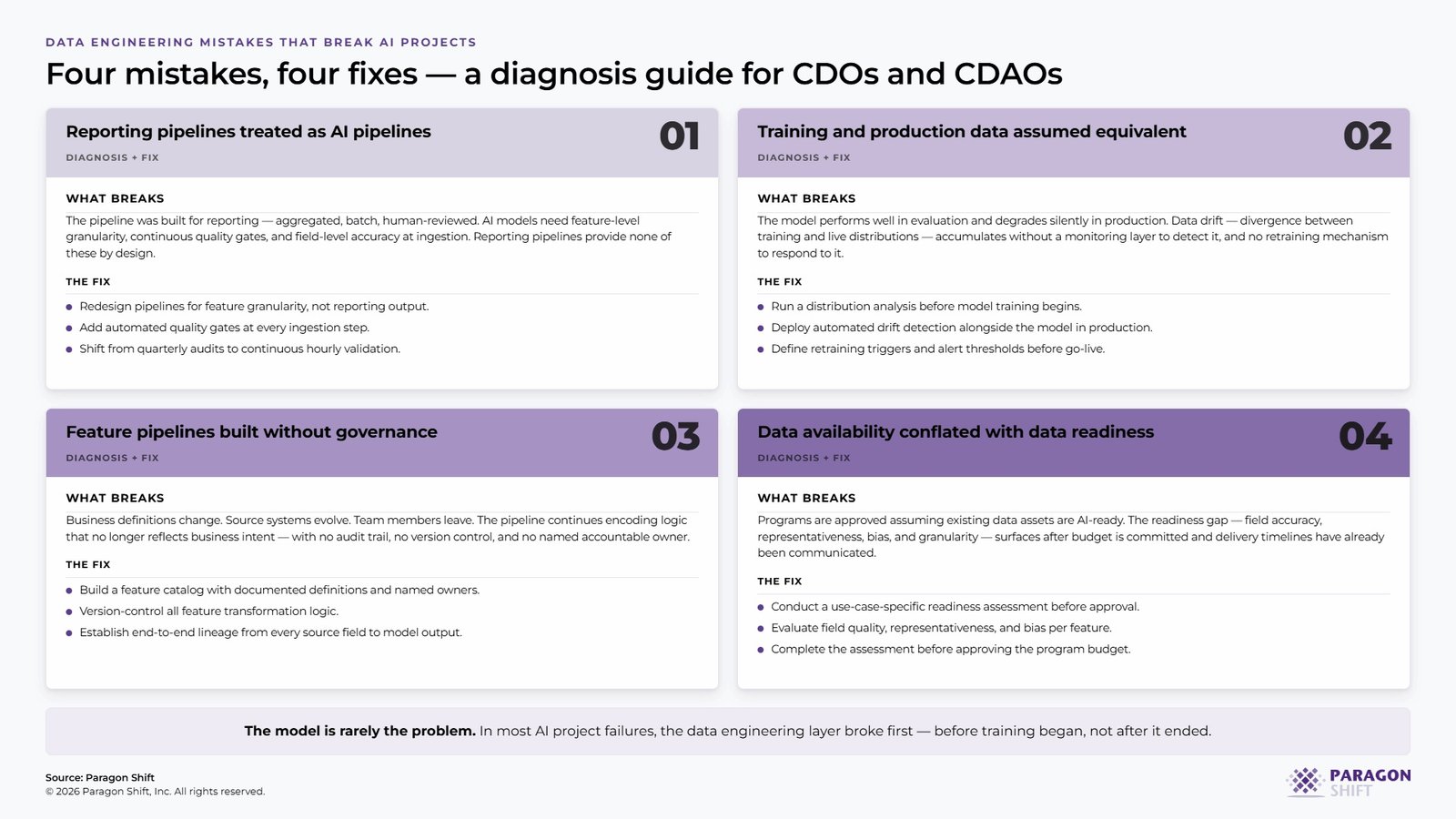
What These Four Mistakes Share
They are all upstream problems that are treated as downstream symptoms.
When an AI model underperforms, the investigation starts with the model. The architecture is reviewed, the hyperparameters are tuned, the training data volume is increased, and a different algorithm is tried. These interventions occasionally work. More often, they produce incremental improvements to a model that is fundamentally limited by the data engineering layer beneath it, and no amount of model optimization closes a pipeline architecture gap, a data drift problem, an ungoverned feature definition, or a training dataset that was never AI-ready.
The organizations that consistently move AI programs from proof-of-concept to production are not the ones with the most sophisticated models. They are the ones who treat data engineering as a first-class discipline resourced, governed, and assessed before model development begins, rather than discovered as a constraint after the program is already behind schedule.
Key Takeaways
1. Gartner predicts that 60 percent of AI projects lacking AI-ready data will be abandoned by 2026. The abandonment is not a model failure. It is a data engineering failure that was present before the model was built.
2. Reporting pipelines and AI pipelines are not interchangeable. The structural differences, batch versus continuous quality gates, aggregated versus feature-level granularity, and human-reviewed versus automated validation, must be addressed before a reporting-oriented data estate can support production AI.
3. Training data and production data must be verified as equivalent before deployment. Data drift monitoring must be deployed alongside the model to detect divergence before it produces visible business consequences.
4. Feature pipeline governance, a documented feature catalog, version-controlled change management, and end-to-end lineage are the most consistently absent governance elements in enterprise AI programs. It is also the most consequential.
5. 92.7 percent of executives identify data as the most significant barrier to AI implementation. In most cases, this is a readiness problem, not an availability problem. The data exists. Its fitness for the specific AI use case has not been verified.
6. Data readiness is a use-case-specific assessment that belongs in the program design phase. CDOs who approve AI programs without a completed data readiness assessment are approving investments that will encounter their most significant obstacles after the budget is committed.
Conclusion
The model is rarely the problem. That is not a comfortable conclusion for organizations that have spent significant budget on AI platforms, model development, and data science talent. But it is the conclusion that the evidence consistently supports, and it is the conclusion that leads to programs that reach production rather than programs that produce impressive demonstrations and stalls.
The four mistakes described in this article are not exotic engineering failures. They are the predictable consequences of treating data engineering as a supporting function for AI, rather than as the foundational discipline that determines whether AI programs succeed. Fixing them does not require new platforms or additional headcount. It requires the organizational commitment to assess, govern, and prepare the data foundation before model development begins, not as a parallel workstream, but as a prerequisite.