Work Hours
Monday to Friday: 7AM - 7PM
Weekend: 10AM - 5PM


Why Many Manufacturers Struggle
to Build a Single Source of Truth
Manufacturers struggle with fragmentation across disconnected systems. Without a unified data layer, operational visibility is delayed,
decisions are inconsistent, and inefficiencies compound. Building a single source of truth is key to improving performance and responsiveness.
Most manufacturers do not have a data problem in the traditional sense. They have too much data. The issue is that it lives in the wrong places, speaks different languages, and answers different questions depending on who is asking and which system they happen to be looking at.
Ask your operations team for OEE on Line 4 last quarter, and they will pull it from the MES historian. Ask your finance team for the same period, and they will pull from the ERP. The two numbers will not match. They never do. And the time your people spend reconciling those numbers, building the spreadsheets that bridge the gap, and arguing in meetings over which version is correct is time that should be spent running the business.
This is the real cost of data fragmentation in manufacturing. It is not a technology problem, strictly speaking. It is a structural one, and it compounds every year you do not address it.
The Systems That Were Never Meant to Talk to Each Other
Modern manufacturing operations typically run on a stack of systems that were each designed to solve a specific problem and were each purchased in a different decade, from a different vendor, with a different integration assumption.
The ERP manages financial data, procurement, order management, and production planning. It was built to answer the question: what should we be producing, and what will it cost? The MES manages shop floor execution such as work orders, quality events, labor tracking, and production genealogy. It answers: what are we actually producing right now, and is it conforming to spec? SCADA and historian systems capture equipment telemetry at intervals that can be measured in milliseconds. Quality management systems hold inspection records. The supply chain platform holds inbound logistics, supplier performance data, and inventory positions at external distribution nodes.
Each of these systems is, on its own, reasonably good at what it does. The problem is that real-time visibility downstream requires integration with shop floor equipment, which typically comprises a mix of old and new equipment employing varying technologies, while Industry 4.0 vertical integration upstream requires connectivity with ERP and other systems, yet many companies still rely on older legacy systems. Every layer of that stack represents a different data model, a different refresh cadence, and a different definition of core business objects like “production order,” “unit cost,” or “on-time delivery.”
When your MES records a work order as closed at 11:47 AM, and your ERP does not reflect that closure until the next batch sync at midnight, you do not have real-time visibility. You have a 12-hour gap wearing the costume of operational data.
At Paragon Shift, our Data Modernization and Custom Solutions & Integrations practices work with manufacturers navigating exactly this environment; operations running a mix of legacy and modern systems, each acquired to solve a specific problem, none of them designed with a shared data architecture in mind.
What Fragmentation Actually Costs
The financial case for addressing this is not subtle. Siemens’ True Cost of Downtime 2024 report found that unscheduled downtime removes 11 percent of annual revenues from the world’s 500 largest companies, totaling $1.4 trillion, an increase from $864 billion in 2019 and 2020. In the automotive sector, the per-hour cost reaches $2.3 million. A meaningful portion of that figure is not caused by equipment failure alone. It is caused by the latency between when a problem appears in one system and when someone with the authority to act on it sees it in another.
Among more than 3,200 global plant maintenance leaders surveyed by ABB, two-thirds of companies dealt with unplanned downtime at least once a month, at a cost of $125,000 per hour.
Beyond downtime, the broader cost of siloed data is staggering. According to Gartner, poor data quality costs organizations an average of $12.9 to $15 million per year in operational inefficiencies and flawed decision-making. IDC research estimates that companies can lose up to 30 percent of revenue annually due to inefficiencies resulting from incorrect or siloed data.
The hidden cost that never shows up cleanly in any report is labor. Forrester research shows that workers lose 12 hours per week searching for key information trapped in silos. In a manufacturing environment, that translates directly to production supervisors spending hours reconciling reports that should be automated, quality engineers manually pulling data from three systems to complete a CAPA, and procurement teams working from inventory positions that are already hours out of date.
A McKinsey report found that companies with unified data systems are 1.5 times more likely to outperform competitors in making data-driven decisions, while a Deloitte report revealed that manufacturers with integrated data systems are 2.5 times more likely to achieve cost and time efficiencies.
Where the Fragmentation Runs Deepest
There are three integration gaps that account for the majority of the pain we see across our manufacturing client base. Each one has a distinct signature, and each requires a different remediation approach.
The ERP-To-MES Gap
This is the most consequential disconnect in most manufacturing environments. ERP systems plan in batch cycles and manage financial constructs such as standard costs, planned quantities, and scheduled start dates. MES systems operate in real time and manage physical reality, actual cycle times, yield losses, non-conformances, and labor events. When these two systems do not share a common data model and a reliable synchronization mechanism, the gap fills with manual workarounds: production coordinators maintaining separate tracking spreadsheets, shift supervisors calling the ERP team to close work orders, and finance teams waiting until month-end to reconcile what the floor actually produced against what the plan expected. The friction is invisible on any org chart, but it is constant.
The Supply Chain Visibility Gap
A significant barrier to digital maturity in manufacturing environments is the challenge of providing seamless data extraction and interoperability, which makes it difficult for manufacturers to gain timely and actionable insights. The lack of standardized industry ontologies further compounds this issue, without common data structures or formats, each supply partner defines and organizes data differently, which hinders cross-platform compatibility and consistent data analysis.
For manufacturers running just-in-time or lean production models, a supplier delivery that is four hours late is not just a logistics event. It is a production schedule rewrite. But if the signal that triggers that rewrite has to travel from a supplier’s ERP to a logistics portal, from a logistics portal to a transportation management system, and from there into a production planning tool via a manual update, the response time is measured in hours rather than minutes. By the time the production scheduler knows there is a problem, the line has already stopped.
The Quality Data Gap
Quality events are among the most time-sensitive signals in any manufacturing operation. A non-conformance on a critical dimension, a process parameter drifting outside of statistical control, a batch that fails incoming inspection, each of these needs to reach the people who can act on it in near real-time. When quality data lives in a standalone QMS that does not feed directly into the MES or the ERP, the result is reactive quality management rather than proactive. Organizations investigate problems that have already shipped rather than catching them before they leave the line.
The Organizational Dimension Nobody Talks About
Technology integration is hard. The organizational dimension of data fragmentation is harder.
In a 2024 survey of manufacturers, 94 percent identified digital transformation as a top priority. Yet the operational reality in most plants is that each functional group has a different system of record, a different definition of key metrics, and a different tolerance for the effort required to share data across departmental boundaries. IT owns the ERP. Operations owns the MES. Quality owns the QMS. Finance owns the reporting layer. Supply chain owns the logistics platform. None of these groups was asked to design their systems as part of a coherent information architecture, and most were not resourced to do so.
The consequence is that when a plant manager asks for a single report that shows production output, first-pass yield, material consumption, and on-time delivery performance in one view, the answer is typically: “That will take a few days — we have to pull from several systems.” That is not a data engineering problem alone. It is a governance problem. It is the result of years of system acquisition without a common data strategy.
According to an American Management Association survey, 83 percent of executives believe their companies have silos, and 97 percent say siloed data has had a negative effect on business. In manufacturing specifically, those effects show up in every dimension that matters to the C-suite: margin compression, customer delivery performance, quality costs, and the ability to respond to operational disruptions before they become financial events.
The Architecture of the Problem
The diagram below illustrates what a fragmented manufacturing data infrastructure typically looks like, and what an integrated approach looks like as a contrast. The fragmented state is not the result of poor decisions; it is the natural output of organizations that added capabilities incrementally over time without a unifying data layer.
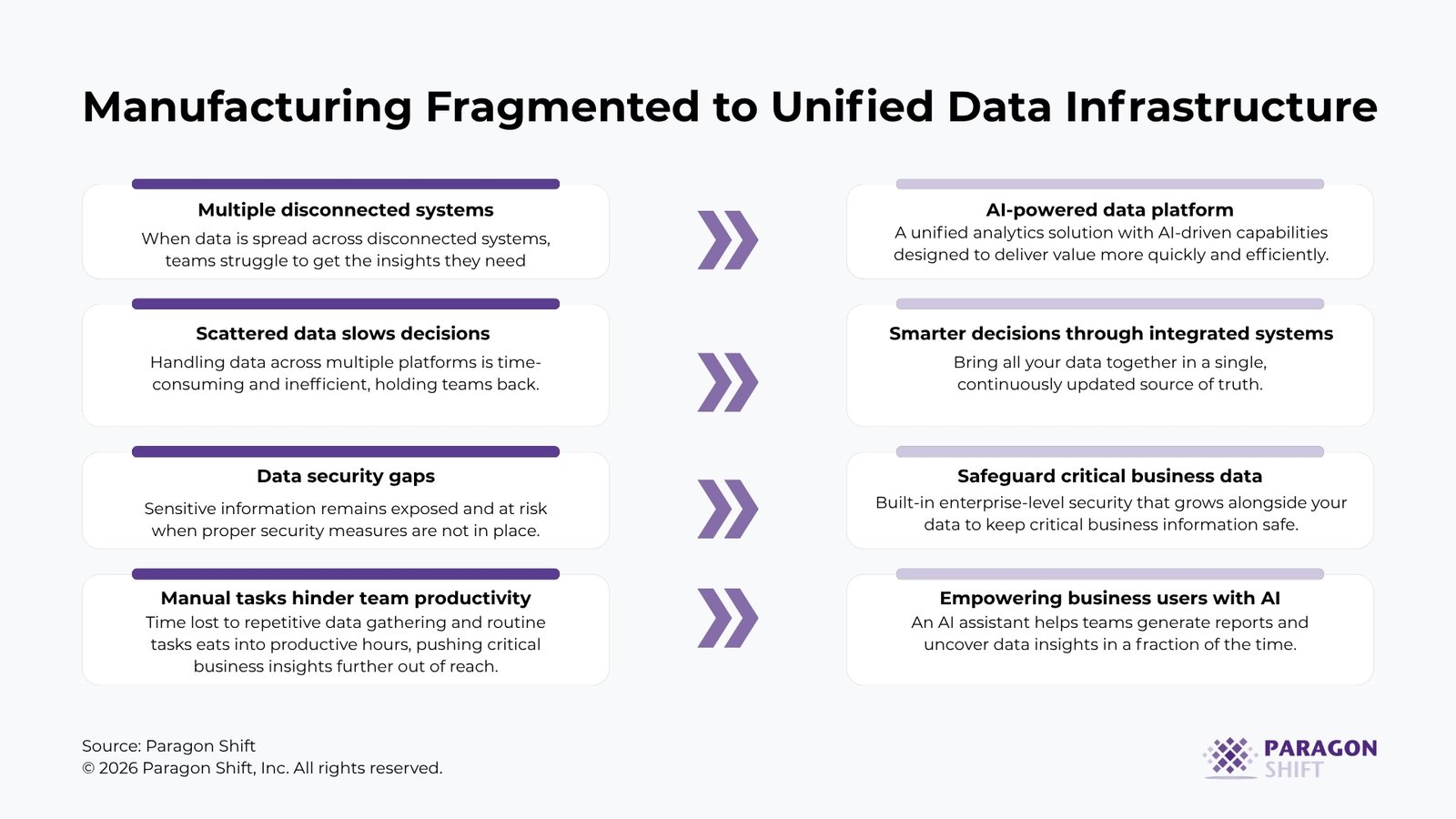
The diagram above maps the two states that most manufacturers find themselves choosing between, often without realizing the choice is available to them.
The Case for a Unified Data Layer
The answer to fragmentation is not a single new system. Replacing your ERP or your MES is a multi-year program with significant organizational risk and questionable ROI for most manufacturers. The more effective path is to introduce a central data layer, a manufacturing data platform that sits above the operational systems and provides a consistent, governed, queryable view of data across all of them.
This is architecturally similar to what cloud data platforms have enabled in other industries for the past decade. In manufacturing, the specific implementation might involve Azure Data Factory pipelines pulling from SAP, a Siemens Opcenter MES, and a historian into a Delta Lake architecture on Databricks or Microsoft Fabric. Paragon Shift’s Data Modernization practice designs and builds exactly these environments, establishing the medallion architecture (bronze, silver, gold) that cleanly separates raw ingestion from curated, analytics-ready data. The key is not the specific technology stack. It is the separation of concerns: operational systems continue to do what they are good at, and the data platform handles integration, harmonization, and analytical consumption.
The benefits are measurable and not hypothetical. According to McKinsey, companies that leverage advanced data analytics see 15 to 20 percent productivity gains in manufacturing. Organizations that have built unified data environments report faster CAPA cycles, improved OEE through predictive maintenance, and supply chain response times that allow production schedules to adjust before disruptions become shutdowns rather than after.
For manufacturing organizations that lack the internal resources to build and maintain this environment on an ongoing basis, Paragon Shift’s Managed Analytics Services provides continuous monitoring, optimization, and support of the reporting and analytics ecosystem, allowing operations and IT teams to focus on the business rather than the infrastructure.
According to a Forrester survey, nearly 40 percent of organizations report that data fragmentation significantly limits their ability to drive business growth. That figure understates the problem in manufacturing specifically, where the consequences of fragmented data are not just strategic, but also operational and immediate.
What the Path Forward Requires
Getting to a single source of truth in manufacturing is not primarily a technology project. It is a data governance project with technology enablement.
The sequence that works starts with defining, at the business level, what the critical metrics are and how they should be calculated. “OEE,” “first-pass yield,” “cost of quality,” and “supplier on-time delivery” need agreed-upon definitions before anyone writes a data pipeline. Without that agreement, you will simply replicate your existing disagreements into a new platform.
From there, the architecture work involves mapping which source systems hold the authoritative record for each data domain, designing the integration patterns that bring that data into a central layer with appropriate latency, and building the semantic model that governs how that data is exposed to reporting and analytics tools.
This is not a one-size-fits-all engagement. A job shop with 200 employees and three production cells has a different integration complexity than a multi-site discrete manufacturer running mixed-model assembly. The architecture should fit the operation, not the other way around.
What does not vary is the business case. The cost of maintaining the status quo, in reconciliation labor, in decision latency, in quality response time, and in the inability to build predictive capabilities on top of fragmented data consistently exceeds the cost of building a unified data foundation. Paragon Shift’s AI & Automation services extend this foundation further, layering predictive maintenance models, anomaly detection, and intelligent process automation on top of the unified data layer once it is in place, turning a data infrastructure investment into a sustained operational advantage.
Key Takeaways
1. Data fragmentation in manufacturing is structural, not incidental. It is the predictable result of adding operational systems over time without a shared data strategy.
2. The ERP-to-MES gap is the most consequential disconnect for most manufacturers. Until planned data and actual data share a common definition and a reliable synchronization mechanism, operational reporting will require manual reconciliation.
3. The financial cost is real and well-documented. Unplanned downtime costs the world’s 500 largest manufacturers $1.4 trillion annually, according to ScienceDirect, and a significant portion of that exposure is exacerbated by the latency between when a problem occurs and when the right person sees it.
4. The solution is not to replace your operating systems. It is introducing a central data layer that harmonizes data across those systems and provides a consistent, governed analytical foundation.
5. Data governance precedes architecture. Agreeing on metric definitions and data ownership before designing integration pipelines is what separates successful implementations from ones that recreate old problems in new infrastructure.
6. Companies that leverage advanced data analytics see 15 to 20 percent productivity gains in manufacturing. That is not an aspirational number; it is the return on closing the data gap that most mid-market manufacturers are already paying for.
Conclusion
The manufacturers who gain competitive ground over the next five years will not necessarily be the ones who spend the most on technology. They will be the ones who decide, at the leadership level, that operating without a coherent data strategy is no longer acceptable and then build the architecture that reflects that decision.
The systems you already have are generating the signals you need to run a tighter, more responsive operation. The question is whether those signals are reaching you in time to act on them.
At Paragon Shift, we work with manufacturing organizations across the full data lifecycle, from modernizing the underlying data infrastructure to building the BI and analytics layer that makes operations visible, to deploying the AI and automation capabilities that act on what the data reveals. If your leadership team is ready to move from fragmented systems to a coherent data foundation, we are ready to scope what that looks like for your operation.
Explore Related Services


AI & Automation
Bring intelligence and efficiency to every workflow. Paragon Shift helps organizat…