Work Hours
Monday to Friday: 7AM - 7PM
Weekend: 10AM - 5PM


RPA to AI: What Does End-to-End Intelligent Enterprise Mean?
Here is our perspective on what it means to build an end-to-end intelligent enterprise: most organizations have the components, automation tools, data platforms, AI models, and analytics dashboards, but not the architecture that connects them into a single, self-improving system. This series explains what that architecture looks like, why the stack of Azure/Fabric, Databricks, UiPath, and Power BI makes it achievable, and what it means operationally for financial services and manufacturing organizations building it today.
Most enterprise technology organizations are not short on components. They have automation tools. They have data platforms. They have AI pilots running somewhere. They have analytics dashboards that their leadership team reviews on a schedule. What most of them lack is the architecture that connects those components into a system that learns, adapts, and improves without requiring a new project every time the business wants a better outcome.
That gap between having the components and having the system is what this series is about. It is the gap between an enterprise that runs automation and one that is genuinely intelligent. And it is a gap that the right combination of platforms, correctly sequenced and integrated, can close.
This first perspective defines what end-to-end actually means in architectural terms, introduces the stack: Azure, Microsoft Fabric, Databricks, UiPath, and Power BI, and explains the three angles through which every subsequent post in this series will examine it: automation and process, data management, and decision making. The remaining three posts dive deep on each angle with specific use cases in financial services and manufacturing.
What Does End-To-End Intelligent Enterprise Not Mean
Before defining what end-to-end means, it is worth being precise about what it does not mean because the term is used loosely enough to describe almost anything.
End-to-end does not mean having a tool for every step in a process. An organization that uses three separate platforms for data ingestion, transformation, and reporting has tools for every step. It does not have an end-to-end system. It has a pipeline held together by integrations built at different times by different teams with different assumptions about what the data should look like at each handoff.
End-to-end does not mean automating a process from start to finish. An organization that has deployed an RPA bot to handle the data entry portion of a workflow has automated a step. If that step still requires a human to retrieve the data the bot needs, and if the bot’s output still requires a human to review before the next step can begin, the process is not end-to-end. It is partially automated.
End-to-end does not mean connecting your platforms with APIs. Integration is a technical precondition. An end-to-end system requires something more than data moving between platforms. It requires intelligence flowing between them. The data should make the automation smarter. The automation should feed outcomes back into the data. The decisions should be informed by models that were trained on the results of previous decisions. That is a feedback loop, not an API connection.
What End-To-End Intelligent Enterprise Means
An end-to-end intelligent enterprise stack is an architecture in which five conditions are simultaneously true.
Data Flows Continuously From Source to Decision
Raw data from operational systems, such as transaction records, sensor readings, documents, and event logs, moves through a governed pipeline into a data platform where it is transformed, validated, and made available for both analytics and AI without duplication, without manual intervention, and without latency that makes the insight stale by the time it reaches the decision-maker.
AI Models Operate on Governed, Production-Quality Data
The models that produce predictions, classifications, and recommendations are not running on curated research datasets. They are running on the same data the business operates on, with the quality, lineage, and freshness guarantees that make the model’s outputs sufficiently trustworthy to act on in production.
Automation Executes Decisions Without a Human in the Loop for Routine Cases
When an AI model produces a decision, such as approve this invoice, flag this transaction, adjust this production parameter, the system executes that decision automatically for cases within defined confidence thresholds. Human review is reserved for exceptions, not for routine cases that a governed model can handle reliably.
Outcomes Feed Back Into the System
When an automated decision produces a result, for example, the invoice was processed correctly, the transaction was fraudulent, or the parameter adjustment improved yield, that outcome becomes data. It feeds back into the model as a retraining signal. The system gets better as it operates. Each cycle of action and outcome improves the quality of the next cycle’s decisions.
Governance Spans the Entire Stack
Access controls, lineage, sensitivity classification, audit trails, and change management apply consistently from the source data through the AI model, through the automated action, through the decision surface. There is no layer in the stack where governance stops and uncontrolled operation begins.
These five conditions together describe a system that most enterprises do not yet have, and that the specific stack described in this series is designed to produce.
The Four Layer Stack
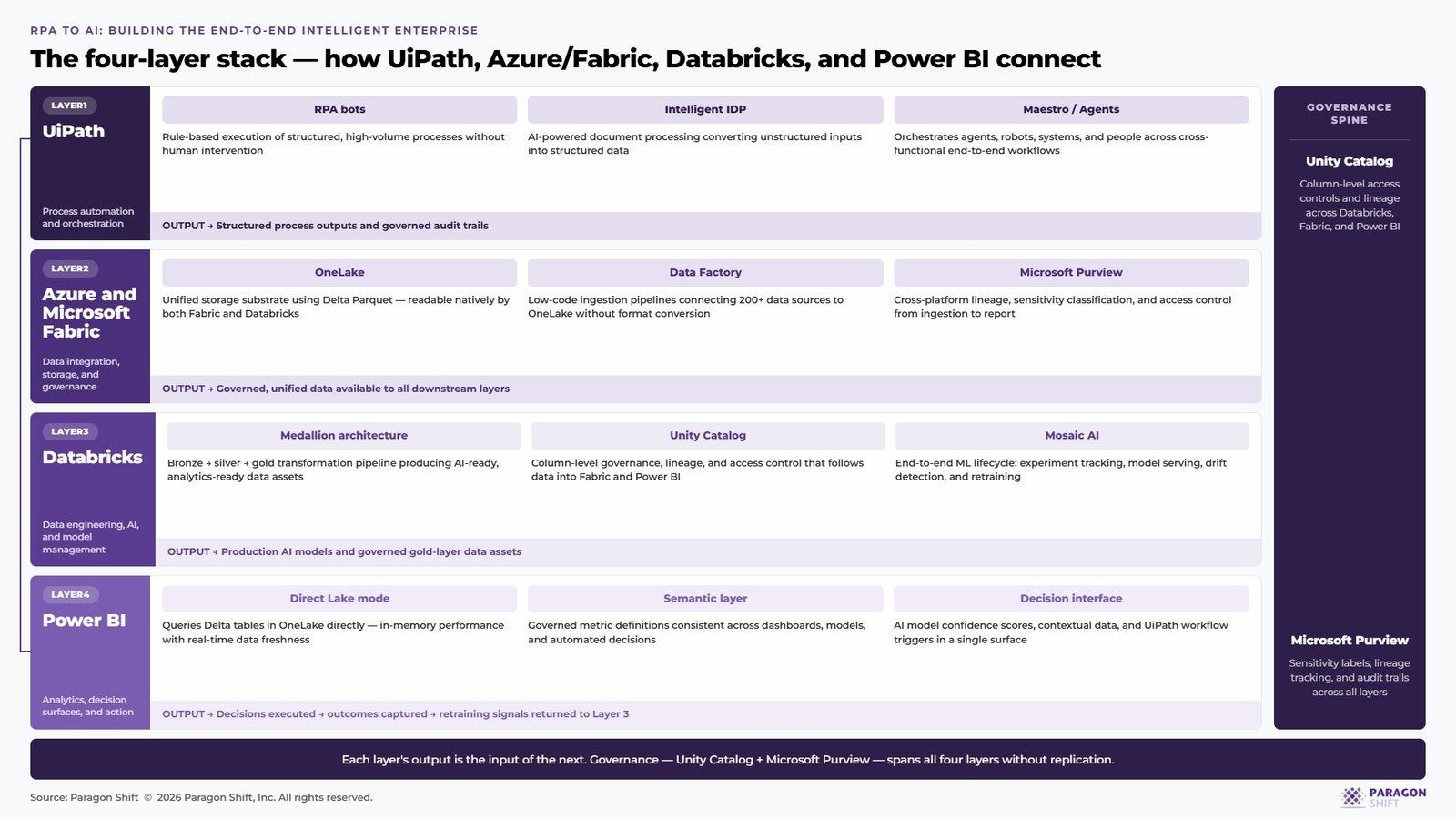
The architecture that realizes end-to-end intelligence in the enterprise today is a four-layer stack. Each layer has a defined role. Each layer’s output is the input of the next. And the governance model anchored in Unity Catalog and Microsoft Purview spans all four.
Layer 1: Process Automation — UiPath
UiPath’s vision for the next generation of enterprise automation centers on agentic automation, a progressive leap from robotic process automation, which combines AI agents, robots, people, and models to deliver enterprise-wide AI transformation for end-to-end processes. In this stack, UiPath is the execution layer. It handles structured, rule-based process automation through conventional RPA bots. It handles unstructured document processing through AI-powered intelligent document processing. And it orchestrates complex, multi-system workflows through UiPath Maestro, its unified control plane for coordinating agents, robots, systems, documents, and people across cross-functional processes.
The two partnerships that make UiPath the right execution layer for this stack are both recent and architecturally significant. UiPath’s integration with Azure AI Foundry enables customers to automate end-to-end processes by using UiPath agents interacting with Azure AI Foundry agents and models, with UiPath Maestro deploying and scaling end-to-end orchestrated workflows across Microsoft and UiPath agents. And UiPath’s validated technology partnership with Databricks introduces integrations connecting the UiPath Platform with the Databricks platform, enabling enterprises to move from data insights to automated action within business processes.
Layer 2: Data Integration and Governance — Azure and Microsoft Fabric
Azure and Microsoft Fabric provide the integration, orchestration, and governance layer. Fabric’s OneLake is the unified storage substrate, the single data lake that all other layers read from and write to. Fabric Data Factory handles the ingestion pipelines that connect over 200 data sources to OneLake. Microsoft Purview extends governance across the entire data estate, providing lineage tracking, sensitivity classification, and access control from raw ingestion through to the Power BI reports that business users consume.
For organizations already running in the Microsoft ecosystem, Azure SQL, Microsoft 365, and Dynamics, Fabric is the natural consolidation layer. It eliminates the data duplication and integration overhead of running separate Azure Synapse, Data Factory, and Power BI Premium estates, and it provides the OneLake endpoint that Databricks can read from and write to natively, using the shared Delta Parquet format that makes the two platforms complementary rather than redundant.
Layer 3: Data Engineering and AI — Databricks
Databricks is the compute-intensive, code-first layer where the engineering work that makes AI production-ready happens. Data engineers run large-scale transformations across the medallion architecture, bronze for raw ingestion, silver for validation and standardization, and gold for analytics-ready output. Data scientists train and validate models against governed feature sets. Machine learning engineers deploy, monitor, and retrain production AI workloads using Mosaic AI.
Unity Catalog is the governance mechanism that connects Databricks to the rest of the stack. Access controls, lineage, and data discovery configured in Unity Catalog follow data through to Microsoft Fabric and Power BI, ensuring that the governance model designed in Databricks does not need to be replicated for each downstream consumer. UiPath delivers built-in governance, auditability, and control across automated workflows and into the Databricks platform, giving organizations visibility into how data, AI agents, and automation interact, which supports end-to-end compliance and responsible AI adoption.
Layer 4: Analytics and Decision Surfaces — Power BI
Power BI is where the output of data engineering and AI layers reaches the people who need to act on it. Direct Lake mode allows Power BI semantic models to query Delta tables in OneLake directly, combining in-memory performance with real-time freshness. The governed semantic layer ensures that the metrics appearing in executive dashboards and operational reports use the same definitions and come from the same sources as the metrics that feed the AI models producing the decisions the automation executes.
This layer closes the loop for human decision-makers. When the automated system handles a case within its confidence threshold, it executes autonomously, and the outcome appears in Power BI as a completed transaction. When a case falls outside the threshold and requires human review, Power BI surfaces it with context, the AI model’s confidence score, relevant data points, and the historical pattern, allowing a decision-maker to act quickly and confidently.
The Three Angles
Each subsequent post in this series examines the stack through one of three lenses. Together, they provide a complete picture of what end-to-end intelligence requires and what it enables.
Angle 1: Automation and Process
How does the execution layer, UiPath, move from RPA bots handling structured tasks to AI agents handling complex, variable, multi-system processes? What are the integration points with Azure AI Foundry and Databricks that make that evolution possible? And what does it look like in practice in a financial services firm automating its loan origination workflow or a manufacturer automating its quality exception handling?
Angle 2: Data Management
How does the data layer, Azure/Fabric, and Databricks produce the governed, AI-ready, continuously updated data foundation that makes the automation intelligent rather than merely fast? What does it take to move from a fragmented data estate with disconnected sources to a unified lakehouse that feeds both analytics and AI without duplication or governance debt? And what does that look like in a bank managing BCBS 239 compliance data or a manufacturer integrating production historian, quality management, and supply chain data?
Angle 3: Decision-Making
How does the combined stack close the gap between data, insight, and action, and how does the feedback loop that connects action outcomes back to model training allow the system to improve over time? What does a Power BI decision surface look like when it is connected to a Databricks AI model that is grounded in UiPath-generated outcome data? And what does that mean for a credit officer making loan decisions or a plant manager making production scheduling decisions?
Why Financial Services & Manufacturing
These two industries are not chosen arbitrarily. They share structural characteristics that make the end-to-end stack particularly valuable and necessary.
Both operate in environments with high transaction volume, significant regulatory complexity, and operational decisions that are made at a frequency and velocity that human-only processes cannot match. A large bank makes thousands of credit decisions per day. A large manufacturer makes thousands of scheduling and quality decisions per shift. In both cases, the decisions are consequential, the data exists to support AI-assisted decision-making, and the regulatory environment creates specific governance requirements for how that data is managed, traced, and audited.
Both industries also have a specific pattern of existing technology investment that the stack must accommodate: legacy core systems that cannot be replaced quickly, significant Microsoft and BI platform investment already in place, and growing demand for AI capability from both business leadership and regulators who are increasingly comfortable with AI-assisted decisions but insistent on explainability and auditability.
The stack described in this series is designed for this environment. It does not require replacing the legacy core. It does not require abandoning existing Microsoft investments. It requires designing the integration, governance, and intelligence layers that sit above and around existing systems, connecting them into the unified, governed, AI-ready data foundation that makes end-to-end intelligence achievable.
Key Takeaways
1. End-to-end intelligence is not a feature of any single platform. It is an architectural condition that has five simultaneously true conditions, requiring a layered stack designed and governed as a unified system.
2. The four-layer stack: UiPath for process automation, Azure/Fabric for data integration and governance, Databricks for data engineering and AI, Power BI for analytics and decision surfaces, is the architecture that produces those five conditions in a governed, scalable enterprise environment.
3. The UiPath-Databricks validated technology partnership, announced in April 2026, connects enterprise data intelligence with agentic automation to accelerate real-time business outcomes, enabling organizations to move from data insights to automated action within business processes.
4. The UiPath-Azure AI Foundry integration, announced in September 2025, allows UiPath agents to interact with Azure AI Foundry agents and models, extending the native bi-directional integration with Microsoft 365 Copilot and Microsoft Copilot Studio.
5. Financial services and manufacturing share the structural characteristics, including high transaction volume, regulatory complexity, existing Microsoft investment, and demand for AI-assisted decisions with auditability, that make this stack the most relevant architecture for their operational reality.
6. The three angles of automation and process, data management, and decision making are not independent concerns. Each one depends on the others. Automation is only as intelligent as the data it acts on. The data is only as valuable as the decisions it enables. And the decisions are only as good as the feedback loop that connects their outcomes back to the system.
Conclusion
The organizations that will lead their industries in the next five years will not be the ones that automated the most processes or deployed the most AI models. They will be the ones who built the architecture by connecting those investments into a single, self-improving system, where data feeds intelligence, intelligence informs decisions, and decisions generate the outcomes that make the next cycle smarter.
That architecture exists today. It is not a roadmap item or a future state. The platforms Azure and Microsoft Fabric, Databricks, UiPath, and Power BI are production-ready, natively integrated, and deployed at scale in financial services and manufacturing organizations that are already operating with the end-to-end intelligence described in this series.
The remaining three posts in this series go inside each layer: the process automation layer that executes intelligent workflows, the data management layer that makes those workflows trustworthy, and the decision-making layer that closes the feedback loop between action and outcome. Read Post 2: Process Intelligence at Scale