Work Hours
Monday to Friday: 7AM - 7PM
Weekend: 10AM - 5PM


How to Move from Siloed Data to Unified Decision Intelligence
Most organizations have more data than they can use and less insight than they need. Our perspective below explains what decision intelligence is, why siloed data is the primary obstacle to it, and
how CEOs and COOs can close the gap between data investment and decision quality.
There is a pattern that most senior leaders recognize, even if they have never named it. A quarterly review goes sideways because the sales and finance teams are working from different revenue figures. A supply chain disruption catches the business off guard because the operations and procurement teams were each tracking inventory from separate systems. A customer retention initiative produces inconclusive results because no one can agree on how to define a churned customer across the CRM and the billing platform.
These are not isolated incidents. They are symptoms of the same underlying condition: a business that has accumulated data faster than it has built the architecture to make that data useful. made. It has changed how decisions get documented after the fact.
The path from that reality to something meaningfully better has a name. It is called decision intelligence. And the obstacle standing between most organizations and that destination is not a lack of data or technology. It is siloed data, fragmented, inconsistent, and ungoverned, making every decision slower, less confident, and more expensive than it needs to be.
What Decision Intelligence Means
Before getting into implementation, the term deserves a brief explanation, because it is used loosely enough that it can mean almost anything.
The operational meaning of that definition is worth unpacking. Decision intelligence is not a software category. It is not a dashboard. It is a way of designing and governing how an organization moves from data to action, systematically, repeatedly, and with enough visibility into the process, so that it can be improved over time.
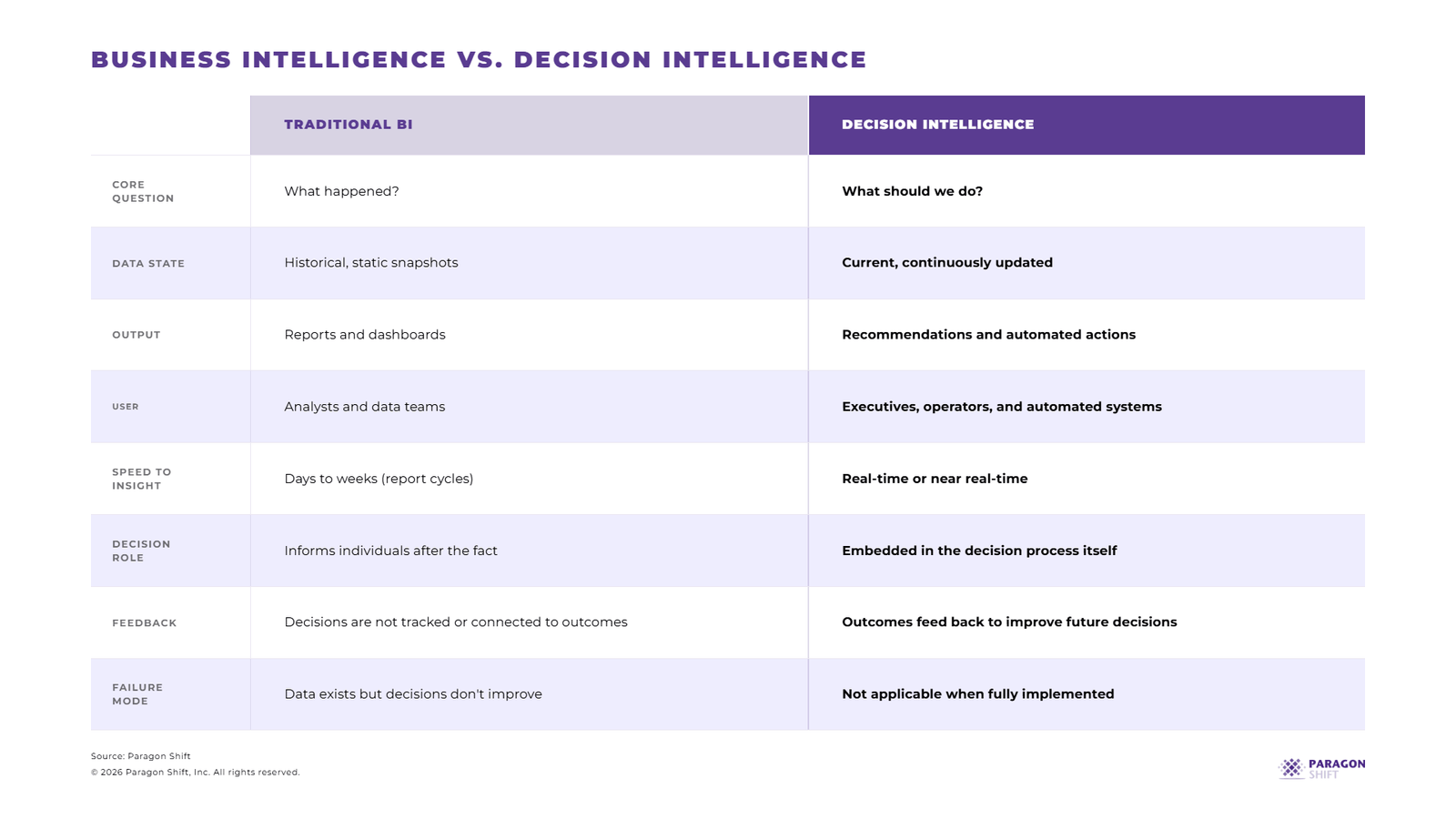
The distinction from traditional business intelligence is meaningful. Business intelligence shows you what happened. It answers historical questions from structured data. Decision intelligence asks: given what we know, what should we do, and how do we know whether that was the right call? It connects the data layer to the decision layer and the decision layer to the outcome layer in a feedback loop that improves over time.
Gartner’s 2025 AI Hype Cycle designated decision intelligence as a transformational technology, specifically noting that historically, decisions happen in departmental silos, rely heavily on intuition and past experience, and are rarely documented or systematically improved. What makes decision intelligence transformational is not the technology itself, but the organizational shift from treating decisions as informal, individual acts to treating them as engineered, documented, and continuously refined processes.
For a CEO or COO, the practical implication is this: the quality of your organization’s decisions is a function of the quality of the data those decisions are based on, and the architecture that connects that data to the people and systems that need to act on it. Siloed data is the primary obstacle to both.
What Siloed Data Costs
The cost of data silos is frequently cited in round numbers that are difficult to trace to a primary source. It is worth being precise about what the evidence shows.
Forrester Consulting research commissioned by Airtable found that workers lose an average of 12 hours per week searching for key information trapped in siloed systems. Meanwhile, Gartner research puts the average annual cost of poor data quality at $12.9 million per organization. Those two figures describe different but related problems: the labor cost of navigating fragmented data and the downstream cost of making decisions on inaccurate, incomplete, or inconsistent data.
Forrester senior analyst Richard Joyce has noted that a 10 percent increase in data accessibility will result in more than $65 million in additional net income for a typical Fortune 1000 company. That figure is the inverse of the cost argument; it expresses the upside of closing the gap rather than the downside of maintaining it.
For a COO, the cost of siloed data shows up in four concrete places. Decisions take longer because the data required to make them has to be assembled manually from multiple sources. Decisions are less reliable because different source systems produce different answers to the same question. Decisions are harder to defend because no one can trace which data was used and whether it was correct at the time. And decisions are harder to learn from because the connection between the data used, the action taken, and the outcome produced is rarely documented in a way that closes the feedback loop.
The Forrester Consulting survey of over a thousand decision-makers found that 79 percent of knowledge workers report that teams throughout their organizations are siloed, and 68 percent say their work is negatively impacted due to a lack of visibility into cross-functional projects. The cost is not just financial. It is organizational as silos produce friction, delay, and the kind of persistent misalignment between functions that show up in every planning cycle and every post-mortem.
Why Siloed Data Persists Despite Years of Investment
Most organizations have invested substantially in data and analytics over the past decade. The persistence of data silos despite that investment is not a paradox, but the predictable result of how those investments were structured.
Analytics and data platform investments are typically made at the function level. The finance team gets a reporting environment. The operations team gets a dashboard. The sales team gets a CRM with built-in analytics. Each investment is justified against the requirements of the team making it. None of them is designed with the cross-functional, decision-level question in mind: what does the CEO see when a strategic decision simultaneously requires synthesizing finance, operations, and customer data?
The answer, in most organizations, is a meeting where three people bring three different spreadsheets and spend the first thirty minutes reconciling numbers.
The second reason silos persist is governance, or more precisely, the absence of it. When every team defines its own metrics, maintains its own data models, and builds its own reporting environment, the organization accumulates a fragmented landscape of locally correct but globally inconsistent information. Revenue means one thing in the sales CRM and something slightly different in the finance warehouse. Customer count is calculated differently by marketing than by product. On-time delivery is measured against the shipping date in one system and the delivery confirmation date in another.
No single investment in analytics tooling solves this problem. It requires a governance decision, a deliberate choice to define metrics at the organizational level, enforce those definitions across systems, and build the data architecture that makes consistent, cross-functional information available to the people and processes that need it.
The Four Layers of Unified Decision Intelligence
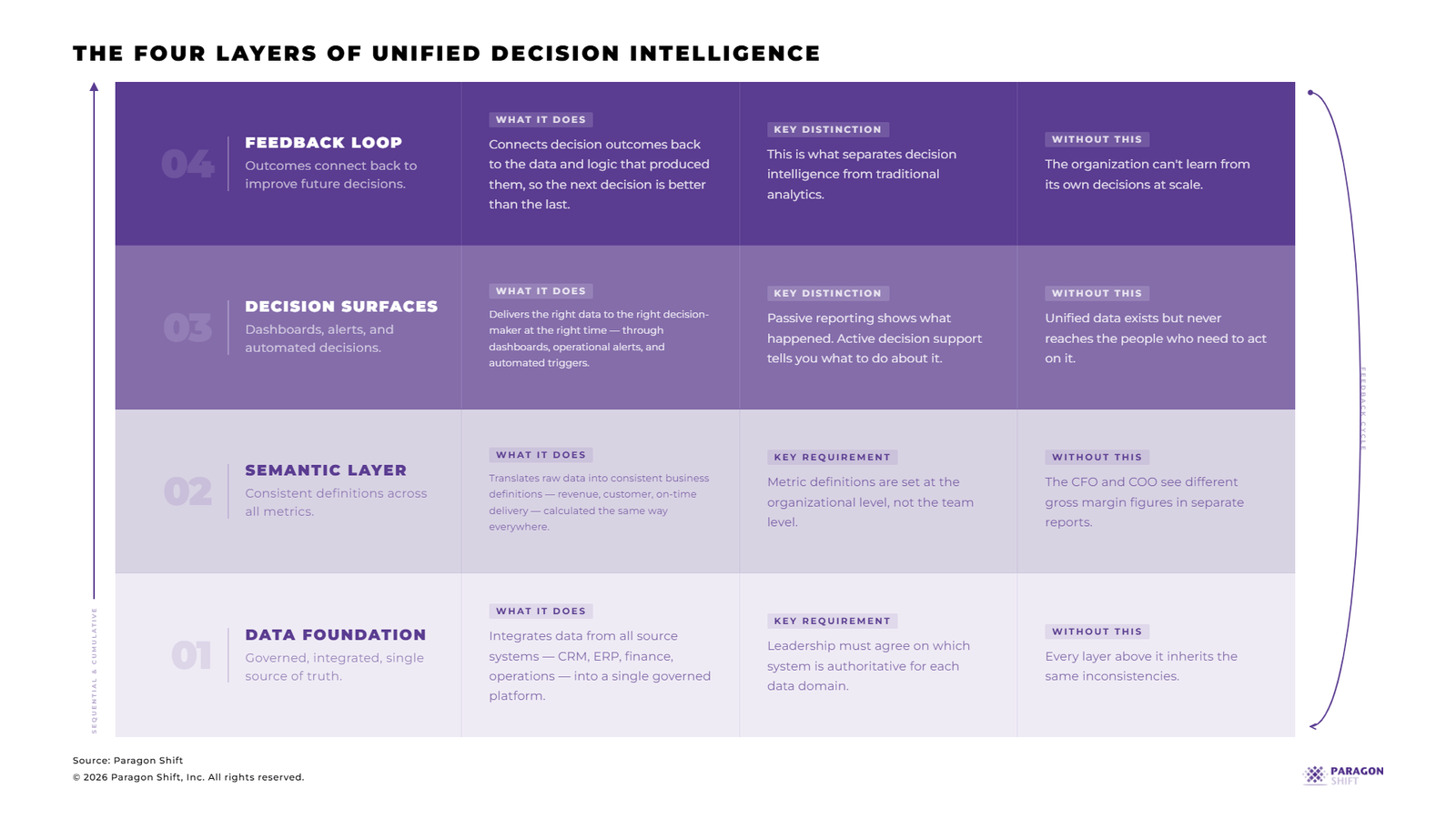
Moving from siloed data to unified decision intelligence is not a single project. It is a layered architecture, built in sequence, where each layer enables the next. Understanding the layers allows a CEO or COO to sequence investments correctly rather than funding them in the wrong order.
Layer 1: A Unified Data Foundation
This is the prerequisite for everything that follows. Before decisions can be made from unified data, the data must be unified. That means a governed data platform, such as a warehouse, a lakehouse, or a federated architecture, where source systems from across the organization contribute data under a common governance model.
The key is not the platform itself. It is the governance decisions that precede the platform: which systems are authoritative for which data, what the shared definitions are for the metrics that matter most, and how data quality is monitored and enforced before it reaches the decision layer. An organization that builds a new data platform on top of ungoverned, inconsistent source data will replicate its existing problems in a more modern environment.
For Paragon Shift’s clients navigating this layer, the most common mistake is treating data unification as a technology project rather than a governance one. The platform choice matters far less than the leadership-level decision about what the organization’s authoritative definitions are and who is accountable for maintaining them.
Layer 2: A Governed Semantic Layer
Once the data is unified, it needs to be interpreted consistently. A semantic layer is the organizational rulebook that sits between the data platform and the reporting and analytics tools that consume it. It defines how every metric is calculated, what business rules apply, and how the data model maps to the concepts that business users work with.
Gartner’s analysis of the 2024 Data and Analytics Summit concluded that to generate value, data and analytics efforts must truly transcend just working with data. They must be centered around informing and operationalizing decisions through connected, contextualized, and continuously updated insights. The semantic layer is the mechanism that produces that contextualization. Without it, the unified data foundation produces consistent raw data but not consistent meaning, and meaning is what decisions require.
A well-governed semantic layer means that when the CFO and the COO look at gross margin in separate reports, they see the same number, calculated the same way, from the same source. It means that when a business unit head drills into revenue by region, the regional boundaries are defined the same way they are in every other report. The semantic layer is not glamorous. It is the most important thing in the analytics environment.
Layer 3: Connected Decision Surfaces
The third layer is where the unified, consistently interpreted data is made available to the people and systems that make decisions. This includes executive dashboards, operational reports, and increasingly, automated decision systems that act on data without requiring a human to review it first.
The distinction that matters here is between passive reporting and active decision support. Passive reporting shows what happened. Active decision support tells the decision-maker what the data suggests they should do, with enough context to evaluate the suggestion. A logistics dashboard that shows delivery performance is passive reporting. A logistics system that flags at-risk shipments before they become missed deliveries, surfaces the root cause, and recommends a corrective action is active decision support.
Gartner’s June 2025 top data and analytics predictions state that half of business decisions will be augmented or automated by AI agents, reflecting the direction toward systematic decision support rather than passive reporting. The path to that state runs through the first three layers: you cannot automate a decision reliably until the data feeding it is unified, consistently defined, and connected to the decision in a governed way.
Layer 4: A Feedback Loop
The final layer is what transforms decision intelligence from a static architecture into a continuously improving system. Every decision made using the platform produces an outcome. Connecting that outcome back to the data and the decision logic that produced it, and making that connection visible to the people who can act on it, is what distinguishes decision intelligence from traditional analytics.
This is the layer that most organizations skip entirely. A dashboard that informs the COO that on-time delivery dropped five points in Q3 is useful. A system that connects the drop to a specific change in supplier lead time, traces that change to the decision to switch carriers two months earlier, and surfaces the data that was available at the time of that carrier decision is decision intelligence. It closes the loop between action and outcome, making the next decision better.
What the Implementation Sequence Looks Like in Practice
The four layers described above are not implemented simultaneously. The sequence is important, and the organizations that get it wrong typically do so in one of two ways: they invest in decision surfaces before the data foundation is ready, producing dashboards that display inconsistent data to executives who quickly stop trusting them; or they build a data foundation without governance, producing a technically capable platform that the business cannot use confidently.
The correct sequence starts with governance. Before any technology is selected or any pipeline is built, the organization needs to answer the following questions at the leadership level: what are the 10 to 15 metrics that the CEO and COO use to run the business, how is each one defined, and which source system is authoritative for each?
That exercise will surface disagreements. Different functions will have different answers. That is not a failure; it is the point. The disagreements that surface in a governance exercise are the same disagreements that currently produce inconsistent numbers in board meetings and planning cycles. Resolving them in the data governance process resolves them everywhere downstream.
From there, the data platform work, i.e., integration, transformation, and quality monitoring, is scoped against the specific metrics and decisions that leadership has identified as priorities. The semantic layer is built to enforce the definitions governance created. The decision surfaces are designed around the specific decisions that the CEO, COO, and business unit leaders are accountable for making.
At Paragon Shift, this sequence is how we structure every data modernization and analytics engagement with operational leadership. The technology choices around which platform, which BI tool, which integration pattern are determined by the governance framework and the decision inventory, not the other way around. Organizations that start with technology and retrofit the governance produce platforms that are technically impressive and operationally underused.
What Success Looks Like, and How Long It Takes
A realistic implementation timeline for an enterprise moving from fragmented data to a functioning first phase of decision intelligence is six to twelve months. That timeline produces a unified data layer for the highest-priority data domains, a governed semantic layer covering the CEO and COO’s core operating metrics, and a set of decision surfaces that replace the spreadsheet reconciliation exercise that currently precedes every major operational review.
The measure of success at that stage is not the platform’s sophistication. It is whether the CFO and COO open a report and get the same number for the same metric, whether the CEO can access a current view of operational performance without waiting for a finance team analyst to assemble it, and whether the weekly leadership meeting spends time on decisions rather than data reconciliation.
From that foundation, subsequent phases extend the unified data layer to additional domains, introduce active decision support for the highest-volume operational decisions, and build the feedback loop mechanisms that connect decision outcomes back to the data and logic that produced them.
Gartner’s 2025 top data and analytics trends specifically identify transitioning from a data-driven to a decision-centric vision as one of the defining imperatives for data and analytics leaders this year. The organizations that reach that state first will not be the ones that made the largest technology investments. They will be the ones who started with a governance conversation, built the data foundation in the right sequence, and treated decision quality as an organizational capability rather than a technology output.
Key Takeaways
1. Gartner research found that 65 percent of organizations still use data selectively to confirm decisions they have already made rather than to drive them. Decision intelligence is the discipline that closes that gap, not by deploying new technology, but by engineering how decisions are made and governed.
2. Data silos are the primary obstacle to decision intelligence. Forrester Consulting research found workers lose an average of 12 hours per week searching for information across disconnected systems, and Gartner estimates poor data quality costs organizations an average of $12.9 million per year. These costs are operational, not abstract.
3. Unified decision intelligence is built in four layers: a governed data foundation, a semantic layer that enforces consistent definitions, connected decision surfaces that turn data into action, and a feedback loop that connects outcomes to the decisions that produced them.
4. The governance conversation precedes the technology decision. Organizations that select a platform before agreeing on metric definitions and data ownership build a capable infrastructure on an ungoverned foundation.
5. The measure of success at the first phase is not platform sophistication. It is whether the leadership team gets the same answer to the same question from two different reports, and whether the weekly operating review spends time on decisions rather than data reconciliation.
6. Gartner’s 2025 AI Hype Cycle designated decision intelligence as transformational, specifically because it bridges the insight-to-action gap that most analytics environments have not yet closed. Closing that gap is a sequencing and governance decision, not a technology decision.
Conclusion
The organizations that will lead their industries in the next decade will be those that systematically close the gap between data and decision, in the right sequence, with governance that prevents inconsistency from rebuilding itself at every new layer of investment.
That gap does not close with a platform purchase. It closes with a governance decision made at the leadership level, a data foundation built to enforce that decision, a semantic layer that makes consistency structural rather than aspirational, and a feedback loop that connects every outcome back to the decision that produced it. Those four layers, built in the right order, are what transform an organization’s data investment from a cost of doing business into a source of competitive advantage.
The measure of success is not impressive architecture. It is whether the leadership team gets the same answer to the same question from any report they open, and whether the organization’s decisions, over time, get faster, more confident, and more defensible because the system supporting them is improving rather than standing still.