Work Hours
Monday to Friday: 7AM - 7PM
Weekend: 10AM - 5PM


Where Should You Automate First?
AN Automation Framework for Enterprises
Most automation programs stall not because the technology fails, but because organizations automate the wrong things first. Below, we share our perspective by providing a
practical sequential automation framework for enterprises to help their CIOs, COOs, and CEOs identify where automation can create the fastest, most durable return.
The question that opens most automation conversations is the wrong one. “What can we automate?” is a technology question. It invites a list of candidates from whoever knows the systems best, which is usually IT or a consulting vendor with something to sell. What gets built from that conversation is a pilot that demonstrates capability rather than one that solves a business problem. The pilot succeeds technically, the ROI is marginal, and the organization concludes, incorrectly, that automation did not work.
The right question is: “Where does automation create the most durable value for this business, given what we are prepared to change?” That question is harder. It requires understanding operations, not just systems. It leads to a different set of candidates, a different sequencing logic, and a meaningfully different outcome.
As of 2024, roughly two-thirds of businesses have automated at least one process, according to McKinsey research, yet the gap between organizations that capture sustained value from automation and those that do not is growing, not closing. The differentiator is not access to technology. It is the discipline to select and sequence automation investments before building anything.
Throughout the reading, we offer a practical automation framework for enterprises for the selection process. It is organized as three sequential gates: qualify, rank, and sequence. Each gate filters the field of automation candidates and produces a cleaner, more credible set of priorities for leadership to act on.
Why Sequencing Matters More Than Selection
Most enterprises have no shortage of processes that could be automated. The typical mid-market or enterprise organization runs hundreds of recurring workflows across finance, operations, HR, customer service, IT, and compliance. The bottleneck is never the list of candidates. It is the absence of a principled method for deciding which ones to pursue first, in what order, and with what level of organizational commitment.
Research across multiple industry studies consistently identifies process selection as the primary challenge in automation programs. Organizations most frequently fail by attempting to automate overly complex processes that lack clear rules, underestimating employee resistance, and encountering integration complexity with legacy systems.
These are not random failures. They share a common root cause: automation was initiated before the business case was properly developed, and the chosen processes were not properly qualified. The technology then gets blamed for what was a prioritization failure.
Data from Camunda’s research show that, on average, roughly 46 percent of organizational processes are currently automated, and that automation failures stem more from complexity and coordination issues than from limitations of the tools themselves. Organizations that treat automation as a portfolio decision with explicit criteria, deliberate sequencing, and defined success measures consistently outperform those that treat it as a series of independent technical projects.
The framework below does not assume a particular technology stack. It applies whether your organization is evaluating robotic process automation, AI-assisted workflows, intelligent document processing, or end-to-end process orchestration. The logic is the same: qualify first, rank second, sequence third.
Gate 1: Qualify — Not Every Process Deserves to Be Automated
The first gate eliminates candidates that should not be automated, regardless of how appealing they look on paper. Automating the wrong process is worse than not automating at all, because it consumes budget, generates resistance, and produces a visible failure that makes the next initiative harder to fund.
A process qualifies for automation consideration when it meets four conditions.
1. It Is Stable
Automation encodes the current state of a process. If the underlying process is still being redesigned or the rules governing it change frequently, automation will need to be rebuilt almost immediately after being deployed. The cardinal error here is automating a broken process, one that has known inefficiencies, unresolved exceptions, or disputed logic. Automation does not fix bad processes. It executes them faster and at a higher volume, which makes the problems larger.
2. It Is Rule-Based or Has Predictable Decision Logic
Automation performs best on highly definable tasks that occur consistently each time, also known as rule-based, standardized, and data-driven. Processes that involve constant exceptions, subjective judgment, or unstable inputs are poor candidates until the exception handling is resolved or an intelligent layer is added to manage it.
3. It Has Structured or Structurable Inputs
A process that depends on unstructured, inconsistent inputs, such as free-form emails, handwritten forms, and phone conversations, requires an additional layer of intelligent document processing or natural language understanding before the underlying workflow can be automated. That is not disqualifying, but it is a materially different investment with different risk characteristics, and it should be evaluated as such.
4. It Has a Defined Owner
Every automated process needs a business owner who is accountable for its performance after go-live. Processes that belong to no one or that multiple teams claim ownership over with inconsistent rules will generate disputes the moment the automation surfaces an edge case. If ownership cannot be established before the build begins, it will become a crisis after.
Any process that does not meet all four conditions is removed from the candidate list at this stage. This is not a permanent exclusion, but an instruction to address the precondition first and return to the automation question later.
Gate 2: Rank — Not All Qualified Processes Have Equal Strategic Value
Once the candidate list has been filtered to processes that are genuinely automation-ready, the second gate applies a ranking logic. The goal is to identify which candidates deliver the most value relative to the effort required to automate them.
Four factors drive the ranking.
1. Volume and Frequency
The economic case for automation is fundamentally a function of repetition. A process that runs ten thousand times per month at a cost of eight minutes per instance represents a materially different opportunity than one that runs fifty times per month. High-volume processes that are highly dependent on employee attention and involvement, such as order processing, data migration, claims handling, and customer data entry, represent the clearest automation opportunities because the economic return scales directly with transaction volume.
2. Error Rate and Its Downstream Cost
Manual processes with high error rates create two types of cost: the direct cost of correction and the indirect cost of decisions made based on incorrect data. In financial services, an erroneous account reconciliation that propagates through downstream reporting has a cost far beyond the time spent on the correction itself. Automating a high-error-rate process with well-defined rules typically generates return through error elimination alone, independent of efficiency gains.
3. Strategic Importance
Some processes are operationally significant rather than strategically significant. They consume resources and produce necessary outputs, but they do not directly touch customer experience, regulatory compliance, or revenue generation. Ranking should weight processes that sit in the critical path of the business, where failure or delay has visible consequences for customers, regulators, or the P&L, above those that are back-office infrastructure.
4. Data Readiness
Automation programs that depend on clean, structured, accessible data perform better and deploy faster than those built on top of fragmented or ungoverned data sources. A process that is otherwise compelling but requires significant data preparation work before automation is viable should be ranked lower in the initial sequence, not eliminated, but treated as a second-wave priority once the data foundation is in place.
Departmental ROI data from a Salesforce survey conducted in late 2024 found that IT departments reported the highest return from automation at 52 percent, followed by operations at 47 percent, customer service at 37 percent, and finance at 30 percent. These figures reflect aggregate performance across organizations with varying levels of process maturity and should be read as directional rather than prescriptive. The actual ranking for any specific organization depends on its own cost structure, error rates, and strategic priorities. The framework is the constant; the inputs are specific to each operation.
Gate 3: Sequence — the Order of Execution Is a Strategic Decision
The third gate addresses the order in which ranked automation candidates are built and deployed. This is where most organizations make their second major mistake: they sequence by technical complexity rather than by business value and organizational readiness.
A common and costly pattern is to begin with a large, high-visibility automation that promises the most impressive ROI on paper, only to discover mid-implementation that the process has more exceptions than anticipated, the data is messier than expected, and the stakeholder group is less aligned than assumed. The program stalls, the budget is exhausted, and the organization has nothing to show for it.
The sequencing logic that consistently produces better outcomes has three layers.
First: Prove value on a bounded, high-confidence candidate.
The first automation should be chosen for demonstrability, not ambition. A process that runs frequently has clean data, clear rules, a willing business owner, and limited integration complexity, producing a live result within weeks rather than months. That result serves two purposes: validating the technical approach and generating organizational credibility, making the next initiative easier to fund and staff.
Second: tackle processes where the data infrastructure is already in place.
Automation programs built on top of an existing data foundation, including a governed data warehouse, a well-structured CRM, and a clean master data model, move faster and fail less often than those that require data remediation as a parallel workstream. Where that foundation does not yet exist, building it is not a detour. It is the precondition.
Third: reserve complex, judgment-intensive processes for later phases.
End-to-end process automation that involves exception handling, multi-system orchestration, and human-in-the-loop checkpoints is a different order of investment from rule-based task automation. It requires more data, more engineering, and more organizational change management. Sequencing it after the organization has accumulated experience, demonstrated early wins, and built internal automation competency produces substantially better outcomes than attempting it first.
At Paragon Shift, we work with organizations to structure automation programs that follow this exact logic, beginning with a current-state assessment of process candidates across the qualify, rank, and sequence dimensions, and building a sequenced roadmap that is grounded in what the organization’s data environment can actually support. The programs that generate durable returns are the ones built on that foundation, not on a vendor’s product roadmap.
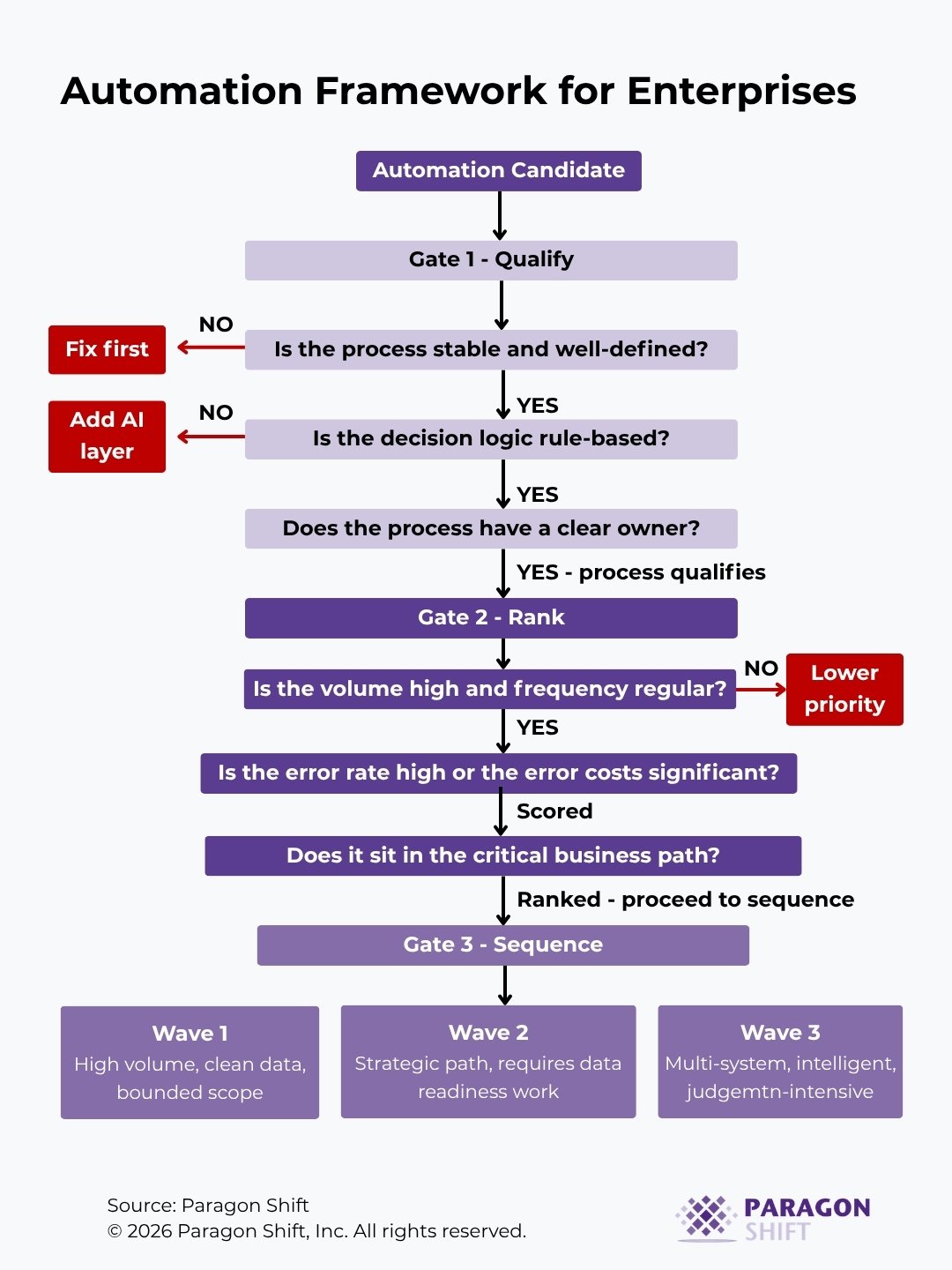
The framework does not guarantee a specific ROI figure because ROI in automation depends heavily on process volume, labor costs, error rates, and implementation quality, all of which vary by organization. What it does guarantee is that the automation investments you make will be ones where the conditions for success were established before the build began, not discovered during it.
That distinction is what separates automation programs that compound value over time from those that generate a series of impressive-sounding announcements with marginal business impact.
Key Takeaways
1. The question that drives most automation conversations, “What can we automate?” produces the wrong answer. The right question is where automation delivers the most durable value, given what the organization is prepared to change.
2. Gate 1 (qualify) eliminates candidates that should not be automated: unstable processes, processes with poorly defined rules, processes without a clear owner, and processes built on unstructured or ungoverned data.
3. Gate 2 (rank) applies four criteria: volume, error rate, strategic importance, and data readiness to prioritize among qualified candidates. Departmental ROI data provides useful benchmarks, but the ranking must reflect each organization’s specific cost structure and priorities.
4. Gate 3 (sequence) orders the execution to build credibility early, leverage existing data infrastructure, and reserve complex multi-system automation for later phases when the organization has the experience and governance to support it.
5. Automation fails from complexity and coordination failures more often than from technology limitations. Sequencing discipline addresses the root cause, not the symptom.
6. The data foundation is not a parallel workstream; it is a precondition. Automation programs built on ungoverned or fragmented data produce fragile outcomes regardless of how well the automation layer is built.
Conclusion
Enterprises that generate sustained value from automation are not the ones that move the fastest. They are the ones that establish the right conditions before building: stable processes, clear ownership, defined success criteria, and a data environment that supports the logic the automation will execute.
The three-gate automation framework for enterprises (qualify, rank, sequence) is not a bureaucratic exercise. It is the fastest, most reliable path to automation programs that deliver visible returns, earn organizational trust, and lay the foundation for the next wave of investment.