Work Hours
Monday to Friday: 7AM - 7PM
Weekend: 10AM - 5PM


Governance in Automation: Preventing
Bot Sprawl
Most organizations that have invested in automation now face a second, quieter problem: a growing inventory of unmonitored, undocumented, and ungoverned bots that accumulate technical debt faster than they are generating returns. Governance is not the bureaucratic overhead that slows automation down. It is the infrastructure that makes automation scale.
There is a pattern that plays out in organizations that have been running automation programs for two or more years. The first year delivered real returns: a handful of well-scoped bots, clearly owned, closely monitored, producing measurable efficiency gains. The second year, encouraged by those early results, the program expanded. Teams built their own automations. Citizen developers entered the picture. The bot count grew.
By year three, no one has a complete inventory of what is running. Some bots were built by people who have since left. Some are executing processes that the business has since changed. Some are running on credentials that belong to service accounts no one manages. Some are failing silently, producing outputs that downstream systems accept without validation. And the maintenance team is spending more time keeping existing automations alive than building new ones.
This is bot sprawl. It is not the result of an automation program that failed. It is the result of one that succeeded without governance keeping pace.
Gartner predicts that by 2028, an average Fortune 500 enterprise will have more than 150,000 AI agents in use, up from fewer than 15 in 2025, generating significant agent sprawl, IT complexity, and management challenges. The bot sprawl problem that organizations are navigating today with RPA is a preview of what is coming at a far larger scale as agentic AI enters the enterprise. Understanding how to govern it now is not preparation for a future problem. It is preparation for a present that is about to get significantly larger.
What Bot Sprawl Is
Bot sprawl is the accumulation of automated processes, such as RPA bots, AI-assisted workflows, scheduled scripts, and increasingly, AI agents that operate without adequate documentation, ownership, monitoring, or lifecycle management. The word “sprawl” is deliberate. It describes growth that has outpaced the governance structures designed to contain it.
It is worth distinguishing bot sprawl from bot failure. A bot that breaks visibly is a problem with a clear resolution path. Bot sprawl produces a different category of problems: automated processes that run, produce outputs, and affect downstream systems or decisions without anyone having a current, accurate understanding of what they are doing or whether they should keep doing it.
Gartner’s 2025 analysis of the automation market is direct on this point: customers consistently face ongoing challenges in bot maintenance, lifecycle governance, and change management as their automation portfolios grow. These are not edge cases. They are the predictable operational costs of automation programs that prioritized deployment speed over governance design.
The conditions that produce bot sprawl are consistent across industries and organization sizes. Automation starts in one department, succeeds, and spreads laterally before any central governance model exists. Citizen development tools lower the barrier to building bots, which increases volume faster than oversight capacity grows. The team that built the first generation of automations moves on, and the institutional knowledge of what each bot does and why each sits nowhere except in the heads of people who are no longer there.
A financial services firm running sixty bots across accounts payable, compliance reporting, and customer onboarding may have clear ownership and documentation for the original twelve. The subsequent forty-eight, built by different teams over eighteen months, may have inconsistent naming conventions, no documented failure handling, shared service account credentials, and no assigned owner accountable for their behavior. That is bot sprawl, and in a regulated environment, it is also a compliance exposure.
The Four Dimensions of Bot Sprawl Risk
Bot sprawl is not a single risk. It is a cluster of related risks that accumulate simultaneously and reinforce each other.
Security and Access Control Risk
Bots operate using credentials. Those credentials have to belong to something, like a service account, a user account, or an API key. In organizations with ungoverned automation portfolios, those credentials are often shared across multiple bots, belong to accounts that are not routinely reviewed, or are held by accounts that have accumulated permissions well beyond what any individual bot requires. When an employee leaves and their credentials are used by three bots that no one has documented, the organization has a privileged access problem that the security team cannot see because it does not appear in any formal credential inventory. Gartner specifically identifies oversharing and data loss as primary risks generated by ungoverned automation sprawl, noting that organizations face misinformation, oversharing, and data loss when agents and bots operate without adequate access controls.
Process Integrity Risk
Bots execute business logic. When that logic was correct at build time, but the underlying business process has since changed, the bot continues to execute the old logic without any signal that something is wrong unless someone explicitly monitors for drift. In a supply chain context, a bot built to route purchase orders below a certain value threshold continues routing at that threshold even after the business revised its approval policy. No one notices until an audit surfaces the discrepancy or a supplier relationship is damaged by incorrect processing.
Maintenance Debt
Every bot in production is a maintenance obligation. It depends on the systems it interacts with remaining stable. When those systems change, and they always do, the bot breaks or produces incorrect outputs. In a well-governed automation program, change management processes notify the automation team when upstream systems are about to change, and maintenance is planned proactively. In a sprawl environment, system changes surface as unexplained failures, and the maintenance team discovers the scope of their obligation only when things stop working. Gartner’s 2025 Hype Cycle for Enterprise Automation notes that organizations are often drowning in disparate automation tools, leading to a critical decision point about whether to consolidate onto governance-capable platforms or continue managing high cost and complexity.
ROI Erosion
The business case for automation is built on the cost savings generated by reliable bots running. When bots fail silently, require constant manual intervention, or are maintained at a cost that approaches the value they were built to produce, the ROI calculation changes significantly. Organizations that calculate automation ROI at the point of deployment and never revisit it are typically unaware of how much of the original return has been eroded by maintenance overhead and unplanned remediation. The payback period for the original investment looks sound. The total cost of ownership over three years tells a different story.
Why Governance Is Not the Enemy of Automation Velocity
The most common objection to automation governance is that it slows programs down. Building a governance framework, establishing a Center of Excellence, and requiring documentation and ownership registration before deployment feels like bureaucratic additions to a program that succeeded by moving fast.
This framing gets the trade-off backwards. The automation programs that move fastest sustainably are the ones with governance in place. The programs that move fastest initially and then stall are the ones that deferred governance until sprawl made implementation expensive.
Gartner’s April 2026 guidance on managing agent sprawl is explicit: organizations that block or restrict the use of AI agents and automation tools rather than governing them are not solving the problem. Employees will route around controls and use shadow automation, which presents far greater risks than governed deployment. The governance goal is not restriction. It is structured enablement, a framework that allows teams to build and deploy automation with appropriate oversight, without creating the conditions for sprawl.
The analogy to software development is instructive. Organizations that adopted DevOps and CI/CD pipelines did not slow down software delivery. They made it faster and more reliable by building quality and governance into the development process rather than treating them as gates at the end. The same principle applies to automation. A governance framework designed as an enabler, including clear approval paths, documentation templates, ownership assignment, and lightweight standardized monitoring requirements, adds minimal friction to individual deployments and prevents the compounding overhead of managing an ungoverned portfolio.
Components of An Effective Automation Governance Framework
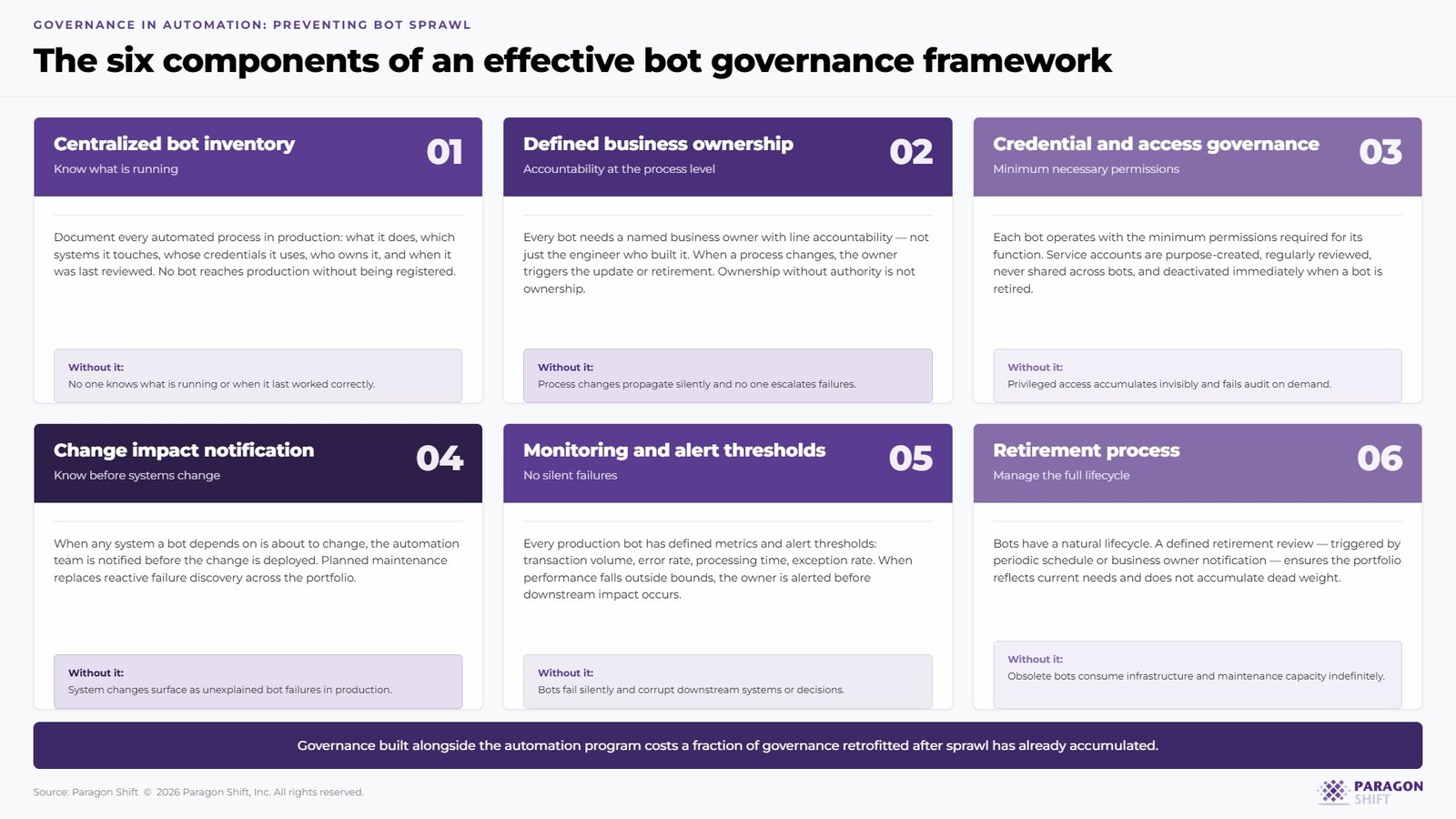
Effective bot governance in an enterprise context has six structural components. Each addresses a specific dimension of sprawl risk.
A Centralized Bot Inventory
The starting point is knowing what exists. A centralized inventory documents every automated process in production: what it does, which systems it interacts with, whose credentials it uses, who owns it, when it was last reviewed, and what monitoring is in place. This does not require a sophisticated tool; only a governed registry, whether maintained in a purpose-built platform or a rigorously maintained database, is sufficient. What it requires is that no bot reaches production without being registered, and that registration is maintained as the bot evolves.
Gartner’s guidance on managing agent sprawl specifically recommends building a centralized agent inventory using AI trust, risk, and security management tools to discover and categorize agents across applications, including from sanctioned tools and from shadow AI solutions. The same principle applies to conventional RPA bots.
Defined Ownership at the Business Level
Every bot in production needs a named business owner; a person with line accountability for its performance and behavior, not just the engineer who built it. When a process changes, the business owner is responsible for ensuring the bot is updated or retired. When a bot produces unexpected outputs, the business owner is the first point of escalation. Ownership without authority is not ownership. The business owner needs the organizational standing to trigger reviews, request changes, and recommend retirement.
Credential and Access Governance
Each bot should operate with the minimum permissions required to execute its function. Service accounts used by bots should be purpose-created, regularly reviewed, and never shared across bots performing different functions. When a bot is retired, its credentials are deactivated. This is standard privileged access management applied to the automation layer, and it is consistently the governance dimension that organizations in regulated industries discover they have not implemented when an audit asks for it.
Change Impact Notification
When a system a bot depends on is about to change, the automation team should know before the change happens. This requires integrating the organization’s change management process and the bot inventory: a workflow that queries the inventory when a system change is planned, identifies which bots interact with that system, and notifies the relevant owners before the change is deployed. In organizations without this mechanism, system changes surface as bot failures rather than planned maintenance events.
Monitoring and Alert Thresholds
Every bot in production should have defined performance metrics and alert thresholds. Transaction volume, error rate, processing time, and exception rate are the standard set. When a bot’s performance falls outside defined bounds, such as processing fewer transactions than expected, generating errors above a defined threshold, or timing out, an alert is triggered to the owner before a silent failure propagates to downstream systems or decisions.
A Retirement Process
Bots have a natural lifecycle. Processes change, systems are decommissioned, and the business problem a bot was built to solve may eventually be solved differently. A governance framework without a retirement process accumulates bots that are no longer useful but continue to consume infrastructure and maintenance capacity. A defined retirement review triggered by a scheduled periodic review or a business owner notification ensures that the portfolio reflects the current state of the organization’s automation needs.
At Paragon Shift, when we conduct automation governance assessments for clients, the most consistent finding is not a lack of intent. Organizations understand that governance matters. The gap is that governance was not designed at the outset, and the cost of retrofitting it onto an existing portfolio is higher than organizations anticipated. The engagements that produce durable governance frameworks are those where the framework is designed in parallel with the first wave of automation deployments, rather than as a remediation activity after sprawl has already accumulated.
The Center of Excellence Model
The organizational structure that consistently produces the best governance outcomes in enterprise automation programs is a Center of Excellence, a central function that owns the automation governance framework, provides shared services to business units deploying automation, and maintains the inventory and standards that prevent sprawl.
The CoE model does not mean that all automation is built centrally. In most mid-market and enterprise organizations, the most effective operating model is federated: business units retain autonomy to identify and build automation for their own processes, but they do so within a governance framework maintained by the CoE and with support from a shared engineering capability that ensures quality and security standards are met.
The CoE’s responsibilities include maintaining the bot inventory, defining and enforcing documentation standards, managing the shared credential and access model, running the change impact notification process, reviewing retirement candidates, and producing portfolio-level reporting that allows CIOs to understand the health and ROI of the automation program as a whole.
Gartner’s 2025 guidance on automation program maturity identifies establishing a Center of Excellence as the mechanism for moving beyond departmental automation to an enterprise-wide automation strategy. Organizations that have not yet established this function typically have the fragmentation described in the opening of this article: automation that works locally, with no visibility into the aggregate portfolio and no mechanism to prevent the next wave of sprawl.
At Paragon Shift, our AI & Automation practice helps organizations design and stand up the CoE operating model alongside automation program development, ensuring that the governance infrastructure grows at the same pace as the bot portfolio rather than chasing it from behind.
What Bot Sprawl Looks Like as AI Agents Enter the Picture
Everything described in this article applies to conventional RPA bots. The same dynamics, including ungoverned growth, credential risk, process integrity failures, and maintenance debt, apply to AI agents at a scale that makes the current RPA governance problem look contained.
Gartner’s April 2026 analysis predicts that by 2028, an average Fortune 500 enterprise will have more than 150,000 AI agents in use, up from fewer than 15 in 2025. An AI agent is not a bot in the conventional sense. It is an autonomous system that can make decisions, take actions across multiple systems, and generate outputs that affect real business processes, often without a human reviewing each step. The governance requirements for that level of autonomy are substantially more demanding than for a rule-based RPA bot.
Gartner’s June 2025 prediction that over 40 percent of agentic AI projects will be canceled by the end of 2027 due to escalating costs, unclear business value, and inadequate risk controls reflects the same pattern that produced the RPA governance failures of the previous decade: deployment ahead of governance, followed by cancellation when the operational consequences became visible.
The organizations that build governance frameworks for their current RPA portfolios are not just solving a present problem. They are building the organizational muscle, i.e., inventory practices, ownership models, monitoring disciplines, and CoE operating model, that will determine whether their AI agent programs scale successfully or replicate the sprawl problem at a higher level of operational risk.
Key Takeaways
1. Bot sprawl is the accumulation of automated processes that operate without adequate documentation, ownership, monitoring, or lifecycle management. It is the predictable consequence of automation programs that prioritize deployment speed over governance design.
3. Governance does not slow automation programs down. Programs with governance in place sustain velocity longer. Programs that defer governance stall when maintenance debt and sprawl accumulate faster than new value is created.
4. The six components of effective automation governance are: a centralized bot inventory, defined business ownership, credential and access governance, change impact notification, performance monitoring with alert thresholds, and a retirement process.
5. The Center of Excellence operating model, including a central governance and federated building, is the organizational structure that consistently produces durable governance outcomes at enterprise scale.
6. Gartner predicts that by 2028, Fortune 500 enterprises will have more than 150,000 AI agents in use. The governance practices built for today’s RPA portfolios are the foundation for safely managing that scale.
Conclusion
The CIOs and CTOs who will navigate the agent sprawl challenge of 2028 without a crisis are the ones who solved the bot sprawl challenge of 2026 with a governance framework. The two problems are structurally identical. The scale is different. The organizational readiness required to manage them is the same.
Governance in automation is not a compliance exercise. It is the infrastructure that determines whether an automation program compounds its returns over time or erodes them. The difference between an automation portfolio that delivers sustained ROI and one that generates maintenance overhead, security exposure, and board-level questions about where the promised savings went is, in most organizations, a governance decision that was or was not made at the right time.
If your organization is working to understand where its current automation governance gaps are or build the framework that will prevent them, Paragon Shift’s AI & Automation practice is designed for exactly this kind of structured assessment. The starting point is always the same: what is running, who owns it, and what would happen if no one were watching. Start that conversation with us.
Why financial institutions struggle to trust their own data