Work Hours
Monday to Friday: 7AM - 7PM
Weekend: 10AM - 5PM


Data Lineage Explained: Why It Matters
More Than You Think
Most organizations know where their data lives. Far fewer can prove how it got there, what happened to it along the way, or whether the number in the executive report reflects what the source system recorded.
Below is our perspective explaining what data lineage is, why it sits at the intersection of governance, AI readiness, and regulatory compliance, and what happens when organizations treat it as optional.
A finance team produces a credit risk report. A regulator asks where the underlying numbers came from. Three people spend two weeks tracing transformations across five systems, none of which were built to communicate with each other, before producing a document that partially answers the question. The answer is not fully defensible. A follow-up inquiry arrives.
This is not a hypothetical case. It is a pattern that plays out routinely in enterprises that have not prioritized data lineage. The consequences range from reporting delays and audit findings to capital surcharges and regulatory fines that reach nine figures.
Data lineage is the documented record of where data comes from, how it moves through systems, and what transformations it undergoes before it reaches the report, the model, or the decision that depends on it. That definition sounds straightforward. The organizational and technical work required to achieve it consistently and maintain it as systems evolve is not.
Our perspective below explains what data lineage is, why it has become a strategic priority rather than a governance checkbox, and what organizations that treat it as optional are risking.
What Data Lineage Means
Gartner defines data lineage as the specification of data origins that show the movement of data over time and provide context as changes occur. It is the answer to three questions that should be answerable for any data asset that informs a significant decision: where did this data come from, what happened to it, and how do I know the transformation was correct?
Lineage operates at two levels. Technical lineage traces data at the system and table levels, mapping the pipeline from the source database through the staging area to the warehouse and into the reporting layer. Business lineage connects that technical path to business meaning, showing which source field populates which metric in which report, which business rule was applied at each transformation step, and who is accountable for each layer.
Most organizations have partial technical lineage, assembled informally through documentation that may or may not be current. Very few have a business lineage that connects the technical path to the specific metrics executives are using to make decisions.
The gap between those two states is where most data trust failures occur. A number in a risk report is only as trustworthy as the lineage that connects it to its source and validates the transformations along the way. Without that lineage, the number is an assertion rather than a demonstrable fact.
Why Lineage Has Become a Regulatory Necessity
For much of its history, data lineage was treated as a data engineering concern, something the platform team managed when auditors asked for it. That framing no longer fits the regulatory reality that CIOs, CDOs, and compliance officers are navigating in 2026.
Five data regulatory frameworks make lineage a hard requirement rather than a governance aspiration.
BCBS 239
The Basel Committee’s Principles for Effective Risk Data Aggregation and Risk Reporting have required comprehensive data lineage for Global Systemically Important Banks since January 2016. The requirement is explicit: data lineage must be complete, covering all data flows across all systems in the organization, and it must be traceable to the attribute level, down to the column in a table. The European Central Bank’s May 2024 Risk Data Aggregation and Risk Reporting guide provided unprecedented specificity on what compliant lineage looks like, escalating requirements that were previously open to interpretation. The enforcement signals from European regulators have shifted from guidance to penalty. Citibank was assessed a $400 million civil money penalty in 2020 for deficiencies in data governance and internal controls, followed by a further $136 million in 2024 for failing to meet remediation milestones. ABN AMRO’s Pillar 2 capital requirement increased by 0.25 percentage points in 2024, with the increase explicitly attributed to improvements required in BCBS 239 compliance. A capital add-on for risk data aggregation deficiencies is a direct and measurable cost of inadequate lineage.
GDPR and CCPA
Privacy regulations require organizations to know exactly where personal data is stored, how it is used, and how it flows through systems. Demonstrating compliance requires lineage. Responding to a data subject access request, executing a deletion request, or proving to a regulator that personal data was not used outside its authorized purpose are all lineage-dependent tasks. Organizations that cannot trace personal data through their pipelines are not compliant, regardless of the policies written in their privacy documentation.
The EU AI Act
The EU AI Act, effective August 2024, requires organizations deploying high-risk AI systems to document data origins, transformations, and quality metrics. Potential fines reach €35 million or 7 percent of global turnover for non-compliance. The regulation makes data lineage a legal requirement for any organization using AI in a context the Act classifies as high-risk, which includes credit scoring, employment screening, and several other enterprise use cases. This is a direct structural connection between lineage maturity and AI deployment authorization.
The regulatory landscape is not softening. Gartner predicts that by 2028, 50 percent of organizations will implement a zero-trust posture for data governance in response to the proliferation of unverified AI-generated data. That posture requires knowing what data is and where it came from before trusting it, which is, at its foundation, a lineage requirement.
OCC Heightened Standards (12 CFR Part 30)
The Office of the Comptroller of the Currency’s Heightened Standards for large national banks and federal savings associations require robust data governance frameworks with clear data ownership, quality standards, and, critically, the ability to trace data from source to use. The Citibank penalties already cited here were imposed under OCC authority, making this the most directly enforced US lineage requirement in financial services today.
SEC Rules on Cybersecurity Risk Management
The SEC’s cybersecurity disclosure rules, effective December 2023, require public companies to disclose material cybersecurity incidents and describe their cybersecurity risk management processes. Knowing where sensitive data lives, how it flows, and which systems it passes through- the definition of data lineage- is a foundational requirement for any organization that needs to assess and report on cybersecurity risk meaningfully. Companies that cannot trace data flows cannot credibly assess their own exposure.
The AI Readiness Connection Organizations Are Missing
Beyond regulatory compliance, data lineage has become the prerequisite infrastructure for AI that most AI programs discover they need too late.
An AI model is only as reliable as the data it was trained on. If the training data contains errors introduced by an undocumented transformation three steps upstream, the model will reflect those errors in its outputs, often invisibly. Without lineage, there is no mechanism to trace a model’s poor performance back to a specific data quality failure, nor to demonstrate to an auditor or a regulator that the model was trained on accurate, authorized, and appropriately governed data.
The practical consequence for CDOs and CIOs is that AI readiness assessments that omit a lineage audit are incomplete. Organizations can select the right model architecture, provision the right compute infrastructure, and hire the right data science team, and still produce AI outputs that cannot be explained, defended, or trusted because the data feeding those models was not traced, validated, and governed at the level of lineage required.
At Paragon Shift, AI readiness assessments we conduct with clients always include a lineage audit as a precondition. The assessment surfaces the transformation layers that lack documentation, the source systems whose data quality is assumed rather than verified, and the pipeline steps where a change to the upstream system would propagate silently to a production model. Addressing those gaps before model development begins is substantially less expensive than discovering them after deployment.
The Operational Case: Impact Analysis and Change Management
The regulatory and AI arguments for data lineage are compelling on their own. The operational argument is often what persuades organizations to prioritize it.
When a source system changes, whether a database schema is updated, a business rule is revised, or a source field is renamed, the teams responsible for downstream reports and models need to know which reports will be affected, how they will be affected, and which data assets need to be updated before the change goes live. Without lineage, this impact analysis is performed manually, through a combination of institutional knowledge and tribal memory, by the people who built the pipelines and who may or may not still be in the organization.
This is the most common and most costly operational failure that lineage gaps produce. A schema change in a core system propagates silently through transformation layers until it appears as a data quality failure in a report or model output, typically in a moment when the organization can least afford it.
With lineage, impact analysis is a query rather than a project. The organization can trace every downstream consumer of any field in any source system, identify which transformations would be affected by a proposed change, and communicate those dependencies before the change is made. That capability substantially reduces the cost and risk of infrastructure evolution, and it is the difference between a proactive and reactive change management process.
The 2025 Salesforce State of Data and Analytics report found that 54 percent of business leaders are not confident that the data they need is even accessible, with persistent issues around accuracy, reliability, and relevance. Lineage does not solve every data quality problem, but it is the diagnostic layer that makes data quality problems findable. Without it, the organization knows something is wrong and cannot locate the cause.
What Good Lineage Looks Like in Practice
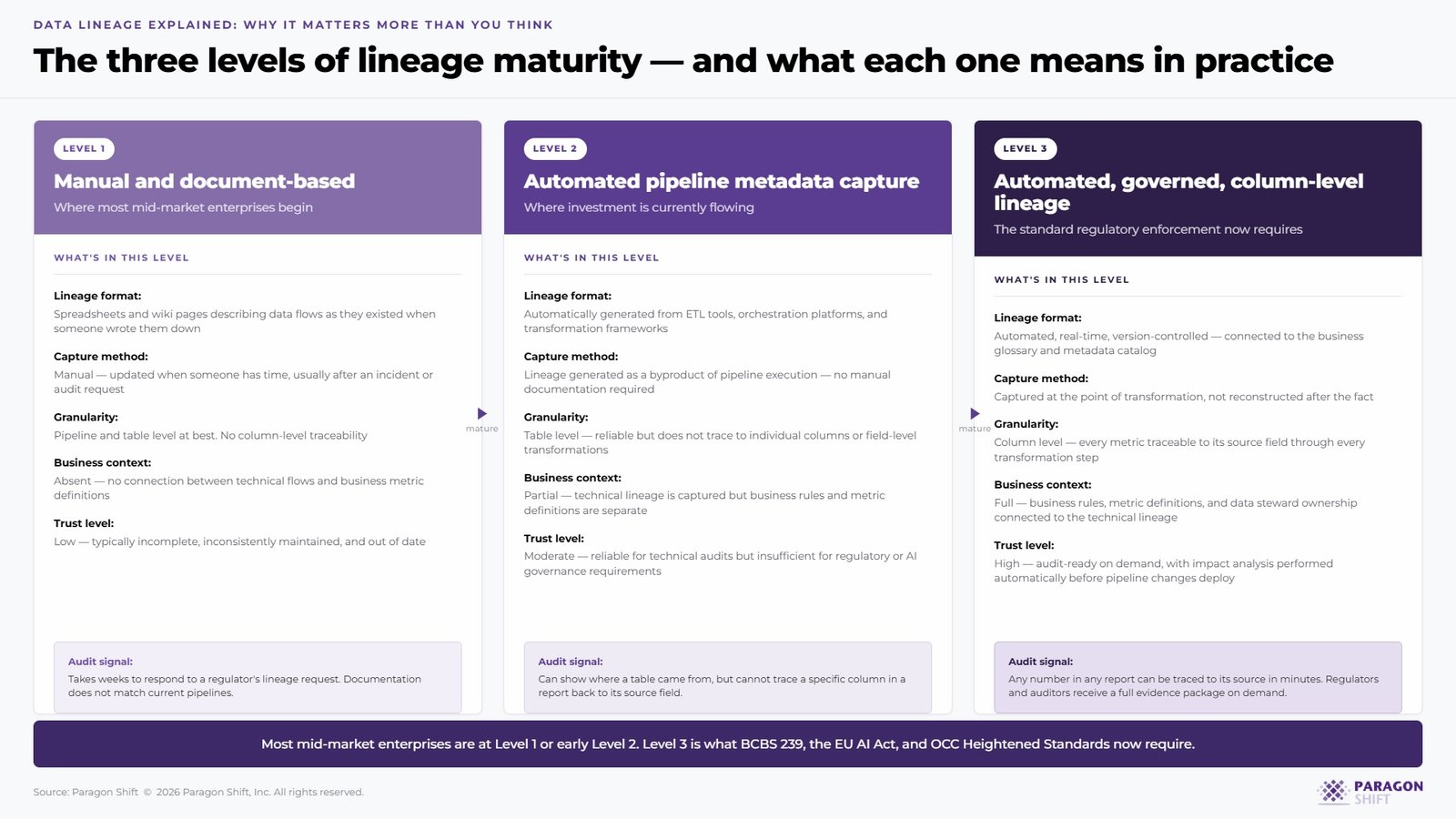
Lineage exists on a maturity spectrum. Understanding where an organization sits on that spectrum is the starting point for any lineage investment.
At the lowest maturity level, lineage is manual and document-based, such as spreadsheets and wiki pages that describe data flows as they existed when they were written down. This documentation is typically incomplete, inconsistently maintained, and no one who needs it for an audit trusts it.
At an intermediate level, lineage is captured automatically from pipeline metadata, ETL tools, orchestration platforms, and transformation frameworks generate lineage as a byproduct of execution. This is more reliable than manual documentation but typically operates at the table level rather than the column level, and it may not capture business context or business rule logic.
At a mature level, lineage is automated, granular to the column level, and connected to the business glossary. Every metric in every report can be traced back to its source field, through every transformation step, with the business rule applied at each step documented and version-controlled. Changes to any part of the pipeline are reflected in the lineage in real time, and impact analysis is performed automatically before changes are deployed.
Most enterprises are at the first or early second level. Reaching the third level requires a deliberate investment in metadata management tooling, a governance process that assigns lineage ownership to data stewards, and an architectural commitment to capturing lineage at the point of transformation rather than reconstructing it afterward.
At Paragon Shift, the lineage implementations we build for clients are designed as a capability that compounds over time, starting with the data domains that carry the highest regulatory or AI-readiness risk, building automated capture into the existing data platform rather than bolting on a separate tool, and establishing the governance process that keeps lineage current as the data environment evolves.
What Lineage Enables That No Other Governance Investment Does
Lineage is not a substitute for data quality management, metadata management, or data governance frameworks. It is the connective tissue that makes those investments produce their intended outcomes.
Data quality rules can be defined and monitored at the point of ingestion. Without lineage, a data quality failure in a production report cannot be traced to the specific source field and transformation step where the error was introduced. The quality program identifies that something is wrong. The lineage tells you where and why.
Data governance frameworks define ownership, policies, and accountability. Without lineage, a data steward accountable for a specific domain cannot see which downstream systems and reports are consuming data from their domain. The governance structure exists on paper. The lineage makes it operational.
AI governance frameworks define how AI models should be built, validated, and monitored. Without lineage, an AI governance review cannot demonstrate which data was used in training, whether that data met the organization’s quality and authorization standards, or how a change to the source data would affect the model’s behavior. The governance policy is written. The lineage provides the evidence that the policy was followed.
Gartner’s 2025 CDAO Agenda Survey found that 89 percent of respondents consider effective data and analytics governance essential for fostering business and technology innovation. Data lineage is the infrastructure layer that makes governance programs demonstrably effective rather than aspirationally documented.
Key Takeaways
1. Data lineage is the documented path from a data asset’s origin through every transformation to its final use in a report, a model, or a decision. Without it, every number in every report is an assertion rather than a demonstrable fact.
2. Gartner now evaluates lineage as a required capability within its Metadata Management Magic Quadrant, reflecting the shift from lineage as an optional feature to a baseline expectation of mature data infrastructure.
3. Regulatory requirements for lineage are explicit and enforceable. BCBS 239 requires end-to-end, column-level lineage for systemically important banks, and recent ECB enforcement actions have demonstrated that regulators are willing to impose capital surcharges and daily fines for persistent deficiencies. The EU AI Act extends lineage requirements to any organization deploying high-risk AI systems, with fines reaching 7 percent of global turnover.
4. AI readiness cannot be assessed without a lineage audit. Gartner’s 2025 research is explicit: AI algorithms require clear data semantics and lineage to produce reliable outcomes. Organizations that deploy AI models without governing the data those models train on are building on an unverifiable foundation.
5. Impact analysis, understanding which downstream systems and reports are affected by any upstream change, is the operational case for lineage investment that recurs with every infrastructure change. Without lineage, this analysis is manual, slow, and incomplete.
6. Lineage is the connective tissue of governance. Data quality programs, governance frameworks, and AI compliance policies all depend on lineage to be operationally meaningful rather than theoretically correct.
Conclusion
Data lineage rarely appears on a strategic priority list until it becomes urgent, a regulatory inquiry, an AI model whose outputs cannot be explained, or a board-level question about a risk figure that no one can trace back to its source. At that point, the absence of lineage is no longer an infrastructure gap. It is a credibility problem, and it is an expensive one to fix reactively.
The organizations that treat lineage as a foundational investment are the ones that close audits faster, deploy AI with greater confidence, and spend less time reconciling data discrepancies that should never have occurred. The technical work required to get there is not trivial, but is well-defined, automated capture at the column level, integration with the existing data platform, and a governance process that assigns ownership and keeps documentation current as the environment evolves.
What makes lineage hard is not the technology. It is the organizational commitment to treat data provenance as a shared responsibility rather than a task that belongs to whoever most recently built the pipeline. That commitment has to come from the CIO, the CDO, or the CDAO, i.e., the people accountable for the data environment and who will be in the room when a regulator or an auditor asks the question that lineage was built to answer.
Paragon Shift’s Data Modernization practice helps CIOs, CDOs, and CDAOs assess the current state of their lineage capability, design the automated lineage architecture that fits their data platform, and build a governance process that keeps lineage current as the organization evolves. Whether your immediate driver is regulatory compliance, AI readiness, or operational impact analysis, the starting point is the same: knowing what your data is, where it came from, and whether the path it took was governed.
Why financial institutions struggle to trust their own data