Work Hours
Monday to Friday: 7AM - 7PM
Weekend: 10AM - 5PM


Data Quality Management: Why Trusted Analytics Requires Governance, Ownership, & Ongoing Care
Data quality is not a state you achieve and maintain by deploying the right tools. It is something that degrades continuously, silently, and at a rate that most organizations do not measure until the consequences surface in a failed AI initiative, a regulatory finding, or a board presentation where no one agrees on the numbers. Our perspective examines what data degradation is, why it happens, how to recognize it before it compounds, and what genuine data quality management requires from the organizations that depend on trusted data to operate.
A financial services firm completes a two-year data modernization program. The platform is modern, the pipelines are clean, the dashboards are live, and the CDO signs off on the project. Twelve months later, a risk analyst flags that the credit exposure reports are producing materially different outputs from what the trading desk expects. The investigation reveals that a source system was updated six months after go-live, changing how a key field was populated. No one updated the transformation logic. The data had been degrading silently for half a year before anyone noticed.
This pattern is familiar to most data leaders who have run large-scale analytics programs. The investment produces results. The results create confidence. The confidence reduces vigilance. And the degradation begins.
Data quality is not a destination. It is a condition that requires active maintenance, defined ownership, and governance that treats data as a living asset rather than a delivered output. The IBM Institute for Business Value’s 2025 CDO Study found that 43 percent of chief operations officers identify data quality issues as their most significant data priority, and that over a quarter of organizations estimate annual losses exceeding five million dollars due to poor data quality. The organizations where data quality is strongest are not the ones that invested the most in their initial build, but the ones that never stopped managing what they built.
What Is Data Degradation?
Data degradation is the gradual deterioration of data quality over time. Unlike a system failure or a pipeline error, it does not announce itself. It accumulates through a combination of source system changes, evolving business rules, manual process inconsistencies, and the natural entropy of data that is produced faster than it is governed.
The term is sometimes used narrowly to describe the physical corruption of stored data at the bit level. In the context of analytics and AI, the more consequential form of degradation is semantic: data that was accurate when it was first collected becomes progressively less accurate as the real-world conditions it was meant to reflect continue to change, while the data does not. A customer record that was complete and correct at the point of acquisition becomes incomplete as the customer’s circumstances evolve, and no update is written back to the source. A product cost field that was populated from a single authoritative source begins returning inconsistent values after a system migration applies a different mapping convention. A compliance flag set according to one regulatory definition becomes unreliable after the regulation is amended, but the definition changes in one system but not another.
The result in each case is the same: data that passes basic validation checks, appears in reports, and gets consumed by models and dashboards, but no longer accurately represents the reality it is supposed to describe.
Why Data Degradation Happens
Data degradation happens because data is not static, but most data management practices treat it as though it were. The causes are structural, not incidental, and they are present in every organization that has not built ongoing quality management into its operating model.
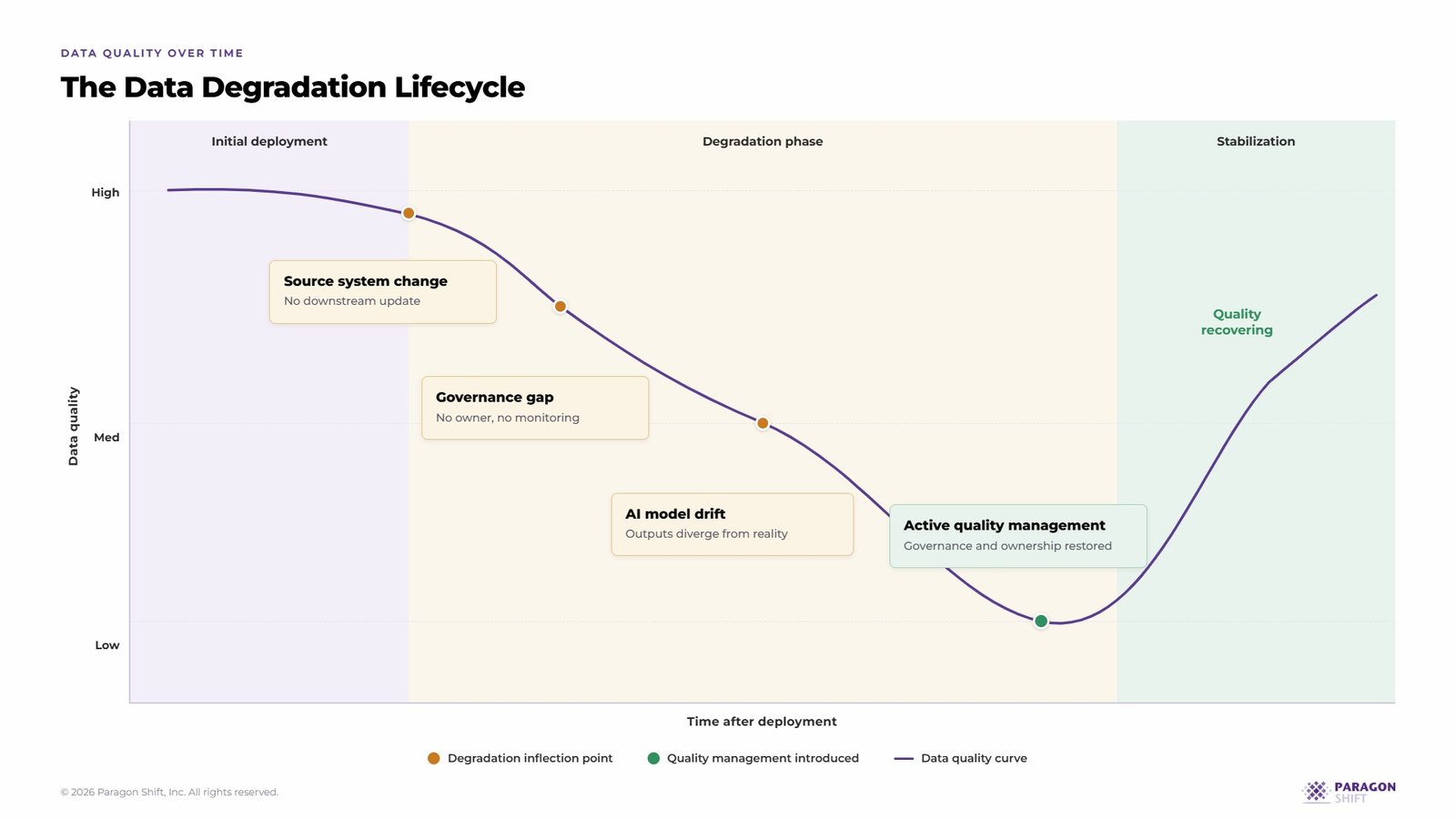
Source systems change without downstream notification. An ERP upgrade, a CRM configuration change, or a new field mapping introduced during a system migration can alter the values that feed downstream pipelines without triggering any alert to the data engineering team. The pipeline continues to run. The dashboard continues to populate. The numbers begin to drift from reality.
Business rules evolve faster than data models. In financial services, the definition of a non-performing loan changes with regulatory guidance. In insurance, risk classification logic changes with actuarial reviews. In healthcare, clinical coding standards are updated on a published schedule, but the operational systems applying them are not always updated in sync. When the business rule changes and the data model does not, the data becomes a snapshot of a definition that no longer applies.
Manual processes introduce inconsistency at the point of entry. In retail, product categorization is often applied manually by merchandising teams who work from different interpretations of the same taxonomy. In manufacturing, quality inspection records are entered by operators who apply different judgments to borderline cases. These inconsistencies are small at the point of entry and significant at scale. According to the IBM Institute for Business Value’s 2025 research, poor data quality often goes unnoticed precisely because its impact rarely appears at the point of failure. It surfaces downstream as lost revenue, operational inefficiency, compliance exposure, and missed opportunities, by which time the root cause is difficult to trace.
Ownership gaps allow degradation to go undetected. When no named individual is accountable for the quality of a specific data domain, quality monitoring happens sporadically, if at all. The data engineering team is accountable for the pipeline. The business unit is accountable for the decision. Neither is accountable for the accuracy of the data that connects the two. In that gap, degradation compounds remain undetected.
The Warning Signs Most Organizations Miss
The most consequential warning signs of data degradation are not technical alerts. They are behavioral signals that data leaders encounter in their day-to-day operations and frequently attribute to other causes.
The first is a recurring disagreement about the numbers. When two business units produce different figures for the same metric in the same reporting period, the instinct is often to investigate the calculation logic or the reporting tool. The more common cause is that the two units are drawing from source data that has diverged over time, each system applying a different version of a definition that was once shared.
The second is the emergence of shadow reporting. When business users stop trusting the governed data platform and start building their own extracts, spreadsheet models, and local databases, it is a reliable signal that the platform’s data quality has degraded to the point where users no longer believe it reflects operational reality. According to Forrester research, between 60 and 73 percent of data within organizations is never successfully used for any strategic purpose. A significant portion of that failure is attributable to trust-erosion rather than access barriers.
The third is AI model drift. When a model that performed well at deployment begins producing outputs that analysts question, the first investigation should include the quality of the training and inference data, not only the model architecture. Models degrade when their input data degrades. A credit risk model trained on accurately labeled historical data begins producing unreliable scores when the source data feeding inference shifts in ways the model was not designed to accommodate.
The fourth is a widening gap between what the data says and what operations observe. In manufacturing, when the yield data in the reporting environment consistently diverges from what the plant floor supervisor knows to be true from direct observation, the data has lost its connection to operational reality. In retail, when the inventory position in the analytics environment does not match what the store team can physically count, the data is no longer trustworthy as a basis for replenishment decisions.
At Paragon Shift, the pattern we encounter most consistently in initial assessments is not that organizations are unaware of their data quality problems. They are often aware. What they lack is a structured way to quantify the degradation, trace it to its source, and assign accountability for resolving it before it compounds further.
The Business Impact of Data Degradation
The financial cost of poor data quality is well documented. Gartner research estimates that poor data quality costs the average organization $12.9 million annually. Research from MIT Sloan Management Review puts the cost of bad data at 15 to 25 percent of revenue for most companies. IBM’s 2025 Institute for Business Value report found that over a quarter of organizations estimate annual losses exceeding five million dollars from poor data quality, with seven percent reporting losses of twenty-five million dollars or more.
These figures describe the aggregate financial impact. The operational impact is more granular and more directly felt by the CDO and VP of Data and Analytics.
In financial services, degraded data in risk reporting produces capital calculations that regulators challenge and remediation timelines that consume months of senior resource time. In insurance, inaccurate policyholder data produces pricing models that generate adverse selection and claims exposure that was not visible at underwriting. In healthcare, incomplete or inconsistently coded clinical data produce population health analytics that misrepresent outcomes and misdirect care management resources. In retail, customer data that has not been maintained produces segmentation models that target personas that no longer exist in the customer base.
None of these impacts announces itself immediately. They accumulate over the same months and quarters that the organization continues to make decisions with confidence in data that is no longer earning that confidence.
Why Data Degradation Is a Major AI Risk
The relationship between data quality and AI program success is direct and consequential. AI and machine learning models do not evaluate the quality of the data they consume. They amplify whatever patterns are present in it, including the patterns introduced by degradation.
Gartner predicts that through 2026, organizations will abandon 60 percent of AI projects unsupported by AI-ready data. Forrester has identified data quality as the primary factor limiting business-to-business generative AI adoption. The 2025 DATAVERSITY Trends in Data Management Survey found that 75 percent of data leaders do not trust their data for decision-making, and that McKinsey research found that eight in ten companies cite data limitations as a roadblock to scaling agentic AI, and that fewer than 10 percent of enterprises that have experimented with AI agents have successfully scaled them to deliver tangible value.
The specific risk that data degradation introduces into AI programs is not limited to model accuracy at initial deployment. It is the ongoing risk of silent model drift as the data feeding inference degrades due to the conditions under which the model was trained. A fraud detection model in financial services that was trained on accurately labeled transaction data begins missing patterns when the transaction data feeding it has been subject to six months of undocumented field-mapping changes. A demand forecasting model in retail, built on clean historical inventory data, begins to overfit to anomalies introduced by inconsistent product categorization. A clinical decision support model in healthcare trained on coded diagnostic data produces unreliable outputs after a coding standard update was applied in some source systems but not in others.
The implication for CDOs and VPs of Data and Analytics is structural: the data quality program and AI governance program cannot be managed independently. Degraded data is not a pre-AI concern that was resolved at the point of platform deployment. It is an ongoing AI risk that requires ongoing management.
What Sustained Data Quality Requires
The organizations that maintain trusted data over time share a consistent set of design decisions that distinguish their programs from those that produced quality data at launch and allowed it to degrade through the months that followed.
Data governance is not a project deliverable. It is an organizational function. The most common failure mode we observe at Paragon Shift is a governance program that was designed, documented, and handed off as a project output rather than embedded as an ongoing operational discipline. Business glossaries that no one maintains. Data quality dashboards that no one is empowered to act on. Data stewardship roles that were created without the authority or the performance accountability to enforce the definitions they were assigned to protect. According to IDC research, organizations with mature data governance programs achieve 24.1 percent revenue improvement and 25.4 percent cost savings improvement from AI. The mechanism is not the governance framework itself. It is the organizational behavior that the framework produces when it is embedded rather than installed.
Data ownership must be assigned at the business level and made non-delegable. Every critical data domain requires a named business owner whose accountability for data quality is explicit and whose performance evaluation reflects it. Not the data engineering team, not the CDO’s office acting as a centralized steward for all domains, but the business units that produce and consume the data and whose decisions depend on it. When ownership is unclear, quality monitoring happens on a schedule that is convenient rather than one that is operationally meaningful.
Quality monitoring must be continuous, not periodic. Data quality audits conducted on a quarterly or annual cycle detect degradation only after it has compounded to the point where it is visible. The organizations that catch degradation early operate continuous quality monitoring, applying rules at the point of ingestion, tracking drift against defined thresholds, and surfacing anomalies to the accountable data owner before they propagate to reports, models, and decisions.
Ongoing support extends the value of the initial investment. At Paragon Shift, our Managed Analytics Services practice works with CDOs and data leaders to monitor, maintain, and optimize the analytics environment on a continuous basis after the initial build is complete. The engagements where data quality is strongest at the twelve-month and twenty-four-month mark are consistently the ones where quality management did not end at go-live. They are the ones where a structured support model kept the governance framework current, the transformation logic aligned with source system changes, and the ownership structure accountable as the business evolved.
The 1-10-100 rule, originally articulated by G. Langford and widely cited in data quality literature, states that it costs one unit to prevent a data quality problem at entry, ten units to correct it after it has entered the system, and one hundred units to remediate the downstream consequences of leaving it unaddressed. In a data environment feeding AI models, executive dashboards, and regulatory reports simultaneously, the cost at the hundred-unit stage is not theoretical. The Gartner and MIT Sloan figures cited earlier describe what it looks like in practice.
Key Takeaways
1. Data quality is not a one-time achievement. It degrades continuously as source systems change, business rules evolve, and manual processes introduce inconsistency at the point of entry. The IBM Institute for Business Value’s 2025 CDO Study found that 43 percent of chief operations officers identify data quality as their most significant data priority, and that over a quarter of organizations estimate annual losses exceeding five million dollars annually from poor data quality.
2. The warning signs of data degradation are behavioral before they are technical. Recurring disagreements about metrics in leadership meetings, shadow reporting by business units that no longer trust the governed platform, AI model drift, and widening gaps between what the data says and what operations observes are all early indicators of a compounding quality problem.
3. Gartner estimates poor data quality costs the average organization $12.9 million annually. Research from MIT Sloan Management Review puts the cost at 15 to 25 percent of revenue for most companies. These are not theoretical figures. They describe the aggregate financial consequence of decisions made on data that was no longer accurate at the time the decision was made.
4. Data degradation is a primary AI risk. Gartner predicts that through 2026, organizations will abandon 60 percent of AI projects unsupported by AI-ready data. Models trained on clean data and deployed into a degrading data environment do not fail visibly. They fail silently, producing outputs that diverge from operational reality while appearing technically functional.
5. Governance is an organizational function, not a project deliverable. IDC research finds that organizations with mature data governance programs achieve 24.1 percent revenue improvement and 25.4 percent improvement in cost savings from AI. The differentiator is governance that is embedded into ongoing operations with named owners, continuous monitoring, and defined accountability, not governance that was documented at project close and left to drift.
6. Ongoing support is the mechanism that closes the gap between a successful initial deployment and sustained data quality. The organizations that maintain trusted data at the twelve-month and twenty-four-month mark are the ones that treated go-live as the beginning of a quality management program, not its conclusion. The 1-10-100 rule holds: the cost of prevention is a fraction of the cost of remediation, and the cost of remediation is a fraction of the cost of operating on unaddressed degradation.
Conclusion
The risk that most CDOs and VPs of Data and Analytics carry is not that their data platform failed. Platforms rarely fail outright. The risk is that the platform succeeded at launch, generated confidence, and then degraded quietly. All of this is while the organization continued to make decisions, train models, and report to regulators on data that had lost its connection to operational reality.
Sustained data quality requires three things that no deployment project can deliver on its own: governance that is embedded into the organization as an ongoing function, ownership that is assigned to the business with real accountability, and support that keeps the environment aligned with the source systems, business rules, and regulatory definitions that change continuously after go-live.
The organizations that get this right are the ones who recognize data quality as an operational discipline and invest in maintaining it with the same rigor they applied to building it.
Why financial institutions struggle to trust their own data