
Moving from On-Prem Data Warehouse
to Fabric: A Migration Strategy
Moving an on-premises data warehouse to Microsoft Fabric is not a lift-and-shift exercise, but an architectural decision with long-term consequences for cost, governance, and analytics capability.
Read more as we cover the business case, the migration approaches, the phase sequencing, and the risks that derail most programs before they reach production.
Most enterprise data warehouses were not designed to fail. They were designed to solve a specific problem at a specific point in time, with the hardware and software constraints that existed when the budget was approved. That is exactly what they did. The problem is that the operational requirements around them have changed substantially, and on-premises infrastructure, by its nature, cannot change at the same pace.
The cost structure has shifted. Hardware refresh cycles, software licensing, infrastructure management, and the IT staff required to keep everything running represent a significant ongoing commitment. Research indicates that an on-premises data warehouse running at a modest one terabyte of storage with a hundred thousand queries per month can cost in the region of half a million dollars annually when the full cost picture is accounted for. That figure does not include the opportunity cost of the analytical capabilities the architecture cannot support, such as real-time ingestion, elastic compute scaling, native machine learning integration, and the kind of unified governance that modern regulatory environments increasingly require.
Microsoft Fabric represents a fundamentally different architectural approach. It is not a rebranded version of Azure Synapse Analytics, though it absorbs many of its capabilities. It is a unified, software-as-a-service analytics platform that brings data engineering, data warehousing, real-time analytics, data science, and Power BI under a single capacity model, against a single storage layer called OneLake. For organizations whose on-premises data warehouse has become a constraint rather than an enabler, the migration question is no longer whether, but how to do it without disrupting the business in the process.
The Business Case Before the Architecture Case
CIOs and CTOs who have attempted cloud migrations know that the business case constructed at the start rarely survives contact with the actual migration. Cost savings that looked compelling in a spreadsheet get eroded by extended timelines, rework, and parallel-run infrastructure. The organizations that navigate this best are the ones that are honest about the full cost picture upfront, rather than anchoring the program on an optimistic projection.
The genuine business drivers for moving to Fabric are worth being specific about.
Total Cost of Ownership
On-premises infrastructure carries costs that cloud environments do not: physical hardware, data center floor space, power and cooling, hardware refresh cycles on a fixed schedule regardless of utilization, and the IT overhead of patch management, backup, and disaster recovery. Cloud environments shift these from capital expenditure to operational expenditure, and introduce elasticity, where you pay for compute when you use it, not for the capacity you might need at peak. On-premises maintenance requirements can be particularly costly over time, potentially requiring hardware modifications as demands scale, and these costs are often underrepresented in original budget models.
Analytics and AI Readiness
Legacy data warehouses were optimized for batch-loaded, structured, SQL-accessible data. They were not designed for the workloads that matter now: streaming ingestion, machine learning feature pipelines, large language model integration, or the kind of exploratory analysis on semi-structured data that modern product and operations teams require. Fabric’s architecture, particularly its lakehouse model built on Delta Lake, with OneLake as the storage substrate, handles structured and unstructured data in the same environment, with the same governance framework applied across both.
Direct Lake and Power BI Performance
For organizations already running Power BI, Fabric introduces Direct Lake mode: a connectivity method that allows Power BI semantic models to query Delta tables in OneLake directly, without the import or DirectQuery latency that constrains large-scale reporting today. The performance and governance implications of this are significant. It is one of the more compelling near-term arguments for migration for organizations that have already invested in Power BI as their analytics surface.
Governance and Compliance Consolidation
Traditional data platforms generate data silos, redundant copies, and fragmented governance. OneLake’s unified approach provides a single storage layer for the entire organization, eliminating the duplication and inconsistency that have characterized enterprise data platforms for the past decade. For organizations under regulatory scrutiny, such as financial services, healthcare, and insurance, the ability to apply a consistent governance model, with lineage tracking and access control, across all workloads is a meaningful risk reduction.
Choosing a Migration Approach Before Choosing a Migration Tool
There are two primary migration approaches available to organizations moving to Fabric, and the choice between them should be driven by the organization’s existing codebase, budget, and tolerance for disruption and not by the vendor’s preferred narrative.
1. Lift-And-Shift
Moving the existing data landscape into Fabric with minimal changes to the underlying structure, ETL logic, or data models. This approach preserves existing investments in code and process, minimizes the risk of disruption during migration, and is appropriate for organizations with a large codebase or constrained timelines. It is not the approach that extracts maximum long-term value from Fabric’s architecture, but a defensible first step, particularly when the alternative is a multi-year refactoring program that consumes the budget before anything ships.
2. Evaluate, Design, and Build
A structured redesign of the target architecture that takes advantage of Fabric’s native capabilities rather than replicating the on-premises model in the cloud. This approach takes longer and costs more upfront, but it produces an environment that is genuinely cloud-native rather than a cloud-hosted version of an on-premises architecture. The organizations that regret not choosing this path are the ones that lift-and-shift a poorly designed on-premises model and discover, six months later, that they have replicated all of its problems in a new environment.
The temptation to carry every existing pattern forward perpetuates the problems that motivated the migration in the first place. A seven-layer nested view is still seven layers in the new environment. Transformations that recalculate dimensions nightly instead of incrementally are still inefficient; they just cost cloud credits instead of on-premises compute cycles.
In practice, most enterprise migrations use a hybrid of both: lift-and-shift for non-critical workloads to prove the infrastructure and build organizational confidence, while redesigning high-priority data domains with a proper medallion architecture from the start.
The Target Architecture: Onelake and the Medallion Model
Before sequencing the migration, it is worth being precise about what the target architecture actually looks like in Fabric, because this determines both the scope of the work and the sequencing logic.
The medallion architecture is the recommended design pattern for Fabric implementations. It organizes data into three distinct layers within OneLake lakehouses: bronze, which stores raw data in the same format as the source system; silver, which contains enriched and standardized data after validation and transformation; and gold, which holds curated, analytics-ready data designed for reporting and consumption.
The architectural significance is that each layer serves a different consumer with different requirements. The bronze layer preserves source data integrity and provides a recovery point. The silver layer is where data quality rules and business logic are applied; this is where the ETL logic from the on-premises environment is translated into modern ELT pipelines using Fabric’s Data Factory or Spark notebooks. The gold layer exposes the output to Power BI semantic models, via Direct Lake, or to downstream consumers via SQL endpoints.
OneLake supports workspace structures organized by environment, by domain, or by medallion layer, depending on the organization’s governance model and team structure. Each pattern has different security and operational implications, and the choice should reflect how the business actually divides data ownership, not how the migration team finds it easiest to structure the workspace.
The decision between using a Fabric Lakehouse and a Fabric Warehouse for the gold layer is one that trips up most first-time Fabric migrations. The Lakehouse exposes Delta tables via a SQL endpoint and is optimized for Direct Lake consumption by Power BI. The Warehouse is a full read-write T-SQL environment with support for stored procedures, schemas, and the kind of complex SQL workloads that teams accustomed to on-premises SQL Server or Teradata will find familiar. For SQL-heavy workloads and environments where row-level security needs to be applied at the warehouse layer, the Fabric Warehouse is the appropriate choice. For Power BI-first reporting at scale against large datasets, Direct Lake from the Lakehouse gold layer will deliver better performance. Many production Fabric environments use both, with the Warehouse serving operational and ad-hoc SQL workloads and the Lakehouse gold layer serving BI consumption.
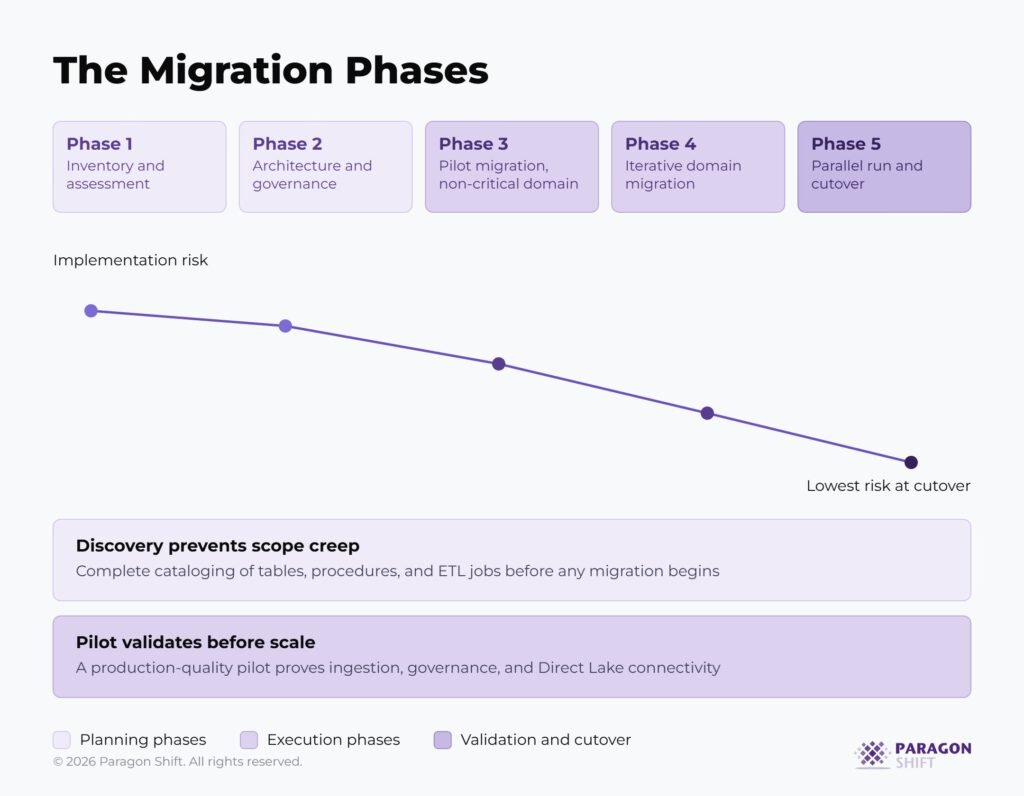
The Migration Phases
Poor planning is the leading cause of data warehouse migration programs exceeding their timelines, with research indicating that a significant proportion of migrations run over due to inadequate profiling and governance preparation. The phase structure below is designed to address that failure mode directly.
Phase 1: Inventory and Assessment
Before any data moves, the team needs a complete, accurate picture of what exists. This means cataloging all source tables, stored procedures, ETL jobs, and downstream dependencies. It means documenting the business logic embedded in transformation code, particularly the logic that exists nowhere except inside a stored procedure someone wrote seven years ago. And it means identifying the data quality issues that currently exist in the warehouse, because they will not disappear during migration. They will resurface as validation failures and downstream anomalies unless addressed deliberately.
Legacy enterprise data warehouses accumulate thousands of stored procedures, complex ETL scripts, and undocumented business logic over decades. The true scope of a migration is almost always larger than what is visible at the surface. Organizations that approach discovery manually tend to miss critical data lineages and dependencies, which is what causes scope creep to surface mid-migration rather than before it begins.
Phase 2: Architecture Design and Governance Framework
This phase produces the target workspace structure, the medallion layer design, the security and access model, and the data governance framework that will be applied in Fabric. Decisions made here, which workloads go to the Lakehouse versus the Warehouse, how workspaces are organized, how row-level security is structured, which pipelines replace which ETL jobs, are expensive to reverse after migration has begun. Time invested here is time not spent on rework later.
Phase 3: Pilot Migration — Non-Critical Domain
The first data moved to Fabric should be a domain that is important enough to be meaningful but not so critical that a failure causes a production incident. This is the proof-of-concept phase, but treated as a production-quality implementation rather than a throwaway experiment. The pilot validates the ingestion patterns, the transformation logic in the silver layer, the governance model, and the Power BI connectivity via Direct Lake, all against real data, at real scale.
Phase 4: Iterative Domain Migration
Following a validated pilot, subsequent data domains are migrated in order of strategic priority. High-value reporting domains that are currently constrained by on-premises performance or refresh latency are strong candidates for early waves. Domains with complex ETL logic and many downstream dependencies are better candidates for later waves, when the team has accumulated migration experience, and the governance framework has been validated against the simpler cases.
Phase 5: Parallel Run and Cutover
Critical workloads should run in parallel on both the on-premises environment and Fabric for a defined period before the cutover. This is not optional risk management; it is the mechanism that gives the business the confidence to commit to the new environment. A phased cutover, executed during a low-traffic business period with the old and new systems running simultaneously, allows organizations to validate live performance and catch discrepancies before they affect production reporting.
At Paragon Shift, our Data Modernization practice structures migrations through exactly this sequence. The engagements that run on time are the ones where Phase 1 is treated as a genuine discovery effort rather than a formality. The ones that run over are almost always the ones where the assessment phase was compressed to accelerate the build, and the complexity that was not surfaced in discovery was surfaced instead in Phase 4, when it is significantly more expensive to address.
The Risks Worth Naming Before the Program Starts
Business Logic Embedded in ETL
The transformation code in a legacy data warehouse is not just plumbing. It encodes business logic, such as calculations, aggregations, and exception handling rules that may not be documented anywhere except the code itself. Migrating that logic to Fabric’s ELT model (where transformation happens after load, using Spark or SQL, rather than before load using traditional ETL tooling) requires understanding what the logic does and why, not just what it says. This is slower than it looks and is consistently underestimated.
Data Quality Exposure
Migration surfaces data quality problems that have been hidden by the structure of the on-premises warehouse. When raw data is landed in the bronze layer, and transformations are applied in silver, issues that were previously masked by hardcoded fixes in stored procedures become visible. This is actually a benefit and an opportunity to address them properly, but requires anticipating that they will appear and building validation into the pipeline design rather than treating them as migration defects.
Governance Before Tooling
Fabric provides excellent governance capabilities through Microsoft Purview integration, workspace-level security, and OneLake’s unified access model. None of these works well without deliberate design up front. Organizations that configure governance as an afterthought, applying access controls and sensitivity labels after the data is already in place, create remediation work and compliance exposure. Poor planning remains the primary cause of data migration failure, and data governance is the dimension that is most consistently treated as a secondary concern until it becomes a primary problem.
Scope of the Migration Versus Scope of the Modernization
The two are related but not identical. A migration moves data from one environment to another. A modernization redesigns the data architecture to be fit for the next decade of analytical and AI workloads. Treating them as the same program trying to migrate and modernize simultaneously, against the same timeline and budget, is one of the most reliable ways to deliver neither.
At Paragon Shift, we help organizations draw that boundary deliberately: identify which aspects of the current architecture are worth carrying forward, which should be redesigned during migration, and which should be deferred to a post-migration modernization phase once the new environment is stable and the team has the experience to design it well.
Key Takeaways
1. The total cost of an on-premises data warehouse includes infrastructure, licensing, IT staffing, and hardware refresh cycles that cloud environments eliminate or transform into elastic, usage-based spend. The full TCO comparison often differs from the initial license cost comparison.
2. Lift-and-shift and evaluate-design-build are not competing strategies; they serve different purposes. Lift-and-shift is appropriate for non-critical workloads and for providing infrastructure. Re-architecture is appropriate for high-priority data domains where Fabric’s native capabilities create genuine long-term value.
3. OneLake and the medallion architecture, bronze for raw ingestion, silver for transformation and validation, and gold for analytics-ready output are the structural foundations of every Fabric migration. The decisions made here determine performance, governance, and maintainability for years after migration.
4. The choice between Fabric Lakehouse and Fabric Warehouse for gold-layer serving depends on the primary consumer. Direct Lake from the Lakehouse delivers the best Power BI performance at scale. The Fabric Warehouse is the right choice for SQL-heavy workloads and complex RBAC requirements.
5. Business logic embedded in legacy stored procedures and ETL code is consistently underestimated as a migration scope. Discovery mapping what the code does and why it is not a formality. It determines whether the migration timeline is credible.
6. Data governance design must precede data movement. Organizations that configure access controls, sensitivity labeling, and lineage tracking after data is in place face remediation work that is harder and more expensive than designing it correctly at the start.
Conclusion
Moving from on-prem data warehouse to Fabric is not a technology refresh. It is an architectural decision with consequences for how the organization manages, governs, and derives value from data for the next several years. Done well, it closes the gap between what the current infrastructure can support and what modern analytical and AI workloads require. Done poorly with inadequate discovery, governance deferred to the end, and a scope that expands once the real complexity is visible, it produces a cloud-hosted version of the same problems.
The organizations that get the most from Fabric migrations are the ones that invest proportionately in the phases that do not feel like progress: the inventory, governance design, architecture decisions, and pilot that validates everything before the critical workloads move.
At Paragon Shift, our Data Modernization practice has guided organizations through this exact journey from initial assessment and architecture design through phased migration and post-cutover optimization. As a Microsoft partner with a Data & AI designation, we bring both the technical depth and the implementation experience to navigate the decisions that determine whether a migration program delivers on its original business case. If your organization is evaluating this path, we are ready to start an assessment of where you are and what the migration would entail.